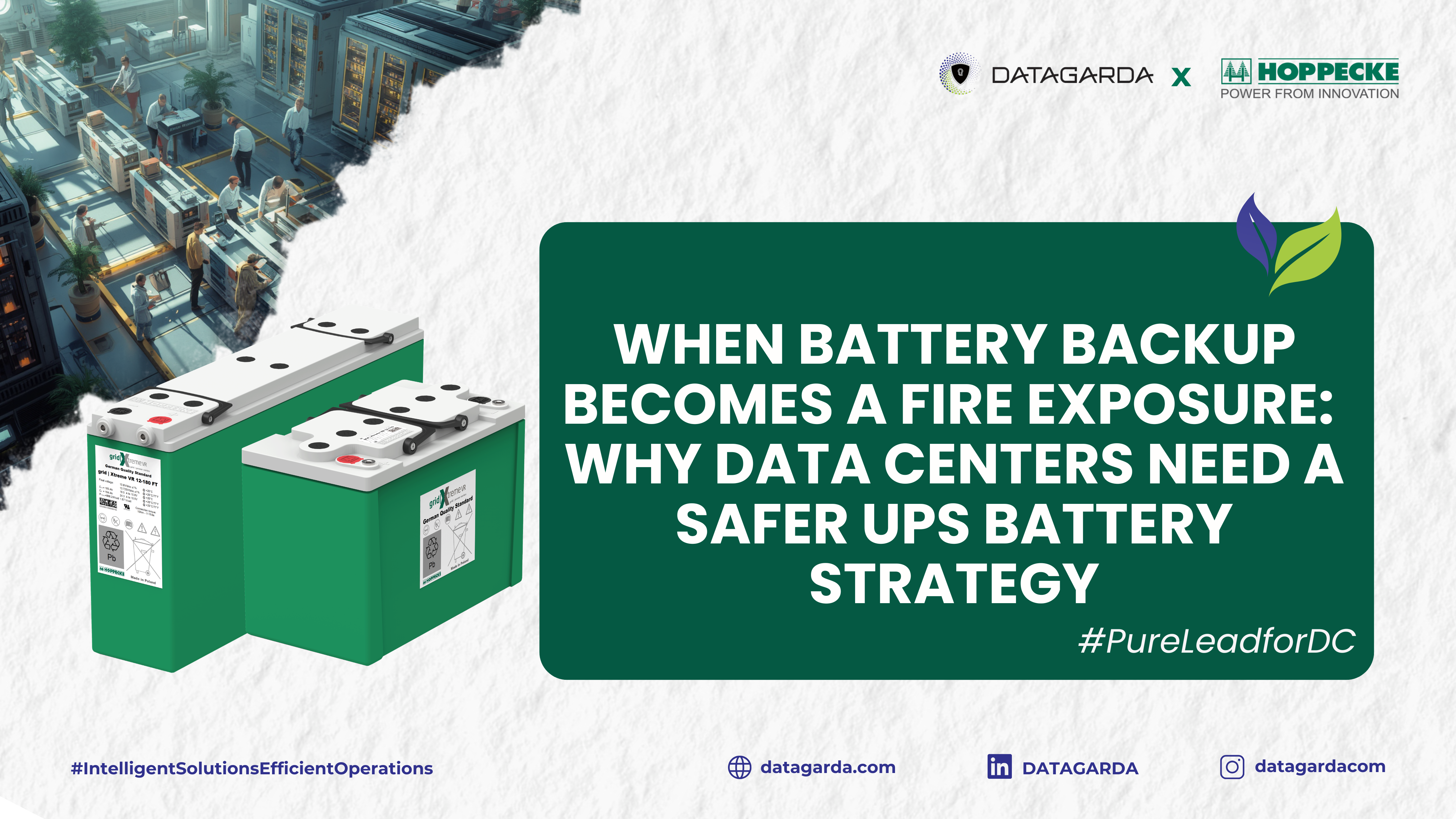
Battery backup systems have always been part of data center resilience.
They support continuity when grid power becomes unstable. They help bridge the gap between power disruption and backup generation. They protect critical workloads, cloud platforms, financial systems, AI infrastructure, and enterprise operations from immediate service interruption.
But as modern data centers evolve, battery backup is no longer only a continuity discussion.
It is becoming a fire exposure discussion.
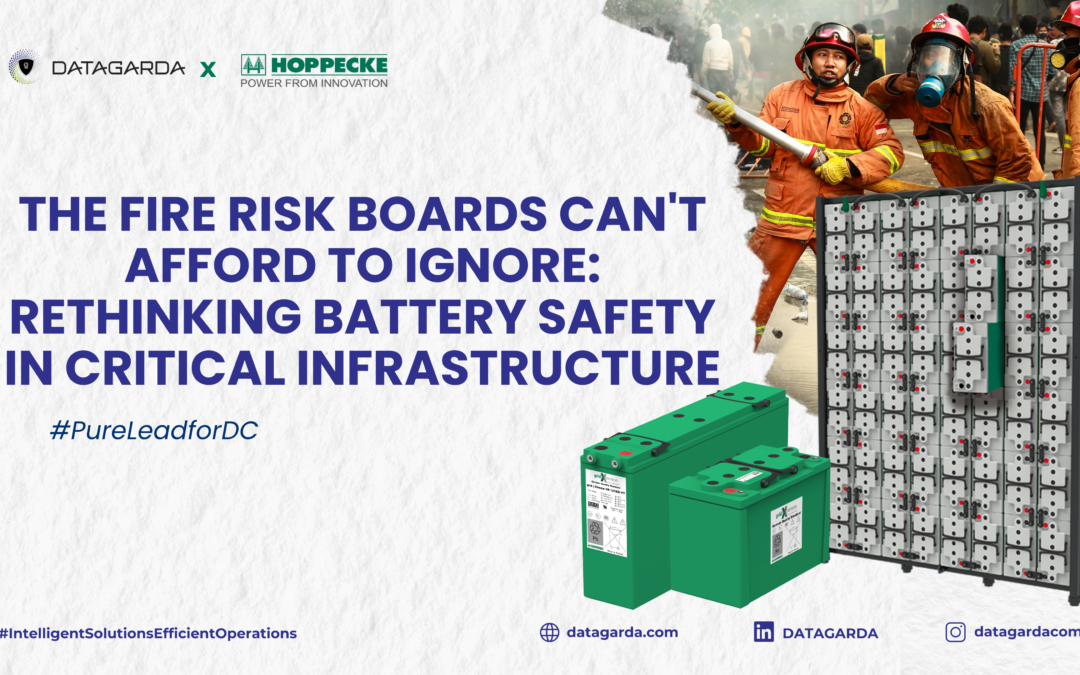
With the rise of high-density infrastructure and AI-driven data center design, some new facilities are integrating lithium-ion battery backup units directly into server racks. This introduces a new type of risk inside data processing equipment rooms: an ignition source that did not previously exist in the same way.
For executive decision-makers, this changes the question from:
“Do we have backup power?”
to:
“Is our backup power strategy safe, governable, insurable, and resilient enough for the next generation of data center risk?”
Data Center Risk Is Becoming More Complex
Data centers are no longer simple technology buildings. They are high-value, high-density, interconnected infrastructure assets.
Swiss Re Institute’s 2026 analysis on AI data center risks highlights that data centers powering AI infrastructure are growing in both scale and complexity, creating challenges for insurance and risk management. Swiss Re notes that construction costs for a single data center location can reach USD 20 billion, and the value can increase further once technology is installed. This value accumulation increases the impact of physical risks, including natural catastrophes, water damage, power continuity vulnerabilities, and new fire ignition sources.
This matters because modern data center risk is no longer limited to construction risk.
Once servers, GPUs, tenants, and services are installed, operational complexity increases. Business interruption, service interruption, loss of rent, physical damage, and equipment failure become more connected. Swiss Re emphasizes that operational risk is about keeping a high-value, multi-tenant critical system continuously available.
In this context, battery backup strategy becomes part of board-level risk governance.
Lithium-Ion BBUs Create a New Fire Exposure
One of the most important risk shifts highlighted by Swiss Re is the integration of lithium-ion battery backup units, or BBUs, into server racks.
According to Swiss Re, fire has historically been a major driver of loss severity in traditional data centers. Although fire accounted for only 10.9% of loss events in FM’s 15-year study, it was responsible for 42.3% of loss costs. Swiss Re also notes that lithium-ion BBUs integrated into server racks create an ignition source “that did not previously exist” inside data processing equipment rooms, potentially increasing both the intensity and frequency of fire losses.
For data center leaders, this is a critical point.
A battery system designed to support uptime can also introduce a new risk if its fire exposure is not properly assessed, contained, monitored, and governed.
This is especially important in high-density environments where thermal stress, power demand, cooling complexity, and equipment concentration are already increasing.
Fire Risk Is Not Only a Technical Issue
Fire risk in data centers affects more than equipment.
It can affect employee safety, structural integrity, customer services, business continuity, insurance coverage, compliance confidence, and reputation.
Swiss Re notes that updated FM loss prevention guidance has evolved in response to changing data center risk. The 2026 revision increased recommended wall fire-resistance ratings from one hour to two hours to limit conflagration and introduced more stringent sprinkler expectations. Swiss Re also cites recent examples including a government-wide shutdown in Korea and a Singapore incident involving an explosion.
For executives, this reinforces an important lesson:
Battery backup decisions should not be treated as isolated equipment decisions. They should be part of a broader fire protection, risk governance, and operational resilience strategy.
AI Data Centers Raise the Stakes
AI infrastructure increases the pressure on power, cooling, and backup systems.
Swiss Re highlights that power-hungry GPUs and high-efficiency cooling significantly increase power requirements. It notes that traditional servers needed 5–15 kW per rack, while AI servers can require more than 100 kW per rack. Swiss Re also identifies power sourcing, battery storage, grid complexity, cooling failure, cyber risk, and concentration risk as emerging contributors to data center risk.
This has direct implications for UPS battery strategy.
As rack density rises, data centers may need backup power systems that are:
Safer
More space-efficient
Easier to maintain
Aligned with fire protection strategy
Compatible with operational procedures
Supported by clear monitoring and escalation
Governed through lifecycle risk management
In other words, UPS battery readiness must evolve with data center risk.
Why Data Centers Need a Safer UPS Battery Strategy
A safer UPS battery strategy should not only focus on runtime, capacity, or footprint.
It should answer executive-level questions such as:
Does the battery system introduce additional fire exposure?
Is the battery infrastructure aligned with fire protection requirements?
Can the system be maintained safely and efficiently?
Does the layout support inspection, access, and emergency response?
Are SOP, MOP, and EOP aligned with the installed infrastructure?
Can the system support long-term resilience and sustainability goals?
Is the risk visible enough for board-level governance?
This is where battery chemistry, system architecture, installation design, monitoring, and operational discipline all matter.
HOPPECKE grid | Xtreme VR: A Pure Lead Alternative for Critical Backup Power
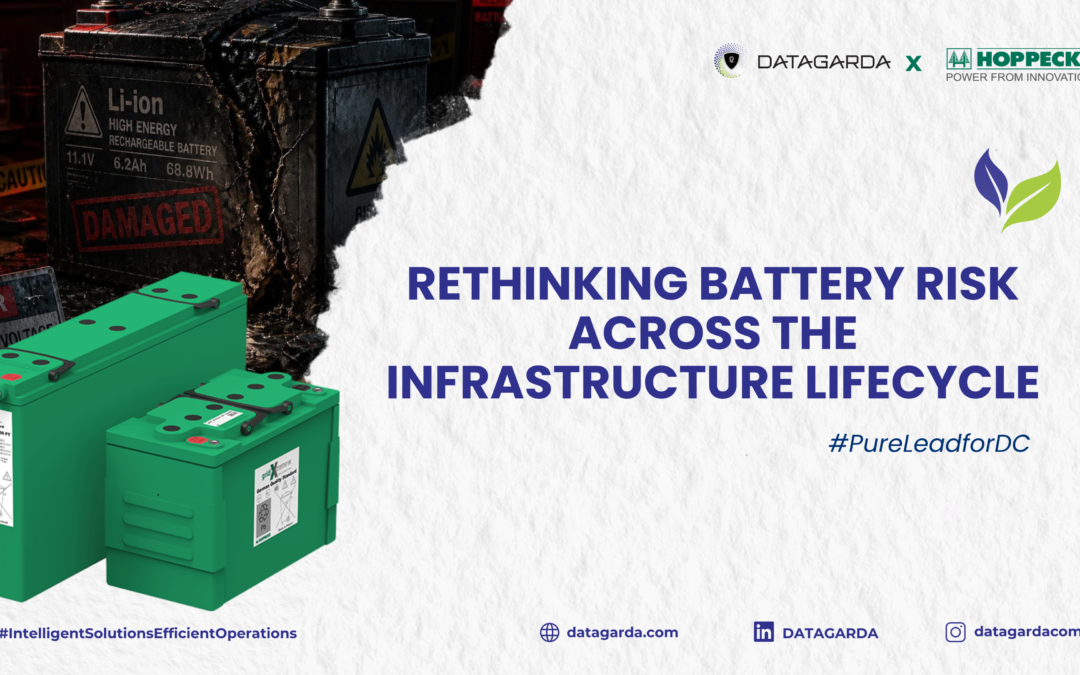
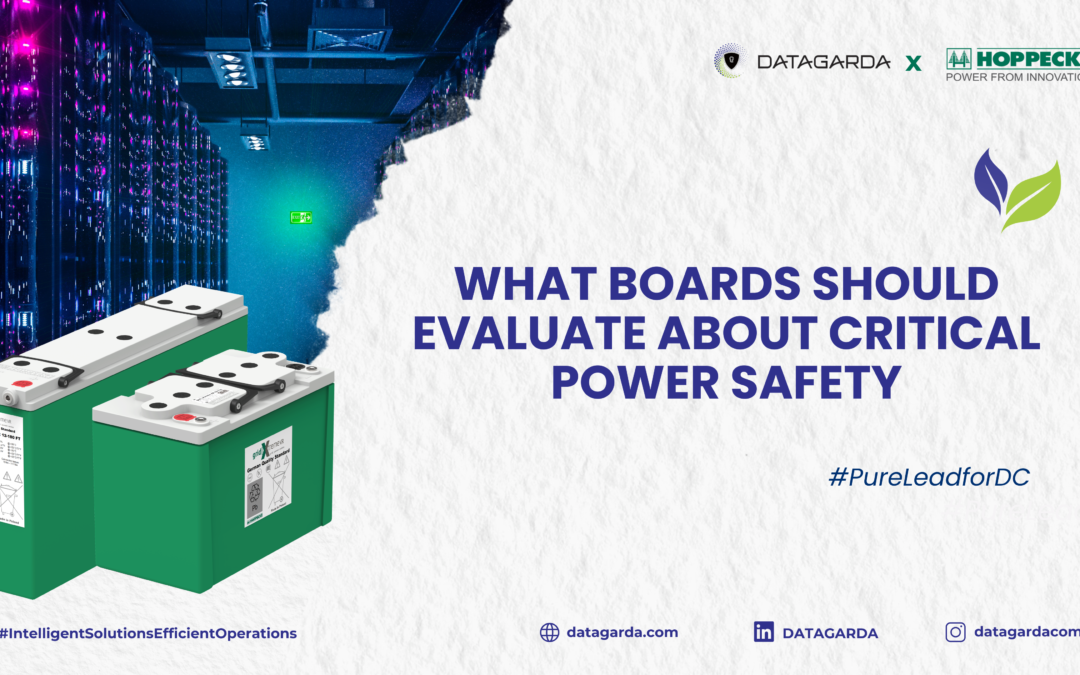
For data centers seeking safer and more resilient UPS battery infrastructure, HOPPECKE grid | Xtreme VR provides a strong alternative through Pure Lead AGM technology.
The HOPPECKE grid | Xtreme VR data sheet describes the product as a next-generation Pure Lead AGM battery designed for demanding standby applications such as data centers and telecommunications. It uses high-performance Pure Lead grid electrodes to support strong corrosion resistance, discharge performance, and long-term stability.
Key attributes include:
Pure Lead technology
Designed for strong discharge performance, corrosion resistance, and long-term reliability in critical standby applications.
15-year design life
The product is designed with a 15-year design life and optimized aging behavior at elevated temperatures, supporting long-term lifecycle planning.
Wide operating temperature range
grid | Xtreme VR is designed for an operating temperature range from -40°C to +55°C, with suitability for permanently high operating temperatures and short peaks up to 60°C.
Reduced maintenance
The product does not require refilling with distilled water, reducing routine maintenance complexity across UPS battery environments.
Flexible installation
The battery can be installed vertically or horizontally on racks, in battery cabinets, or in grid | XtremeStack.
For executive decision-makers, these attributes translate into lifecycle confidence, maintainability, and a more governable critical power strategy.
grid | XtremeStack: Space Efficiency Without Moving Risk Into the Rack
As data centers become denser, footprint becomes a strategic issue.
Battery rooms and UPS environments must support high performance without consuming excessive space. However, space efficiency should not come at the expense of risk visibility or fire safety.
HOPPECKE’s grid | XtremeStack is a modular stacking solution tailored for grid | Xtreme VR top terminal batteries. It supports compact installation, modular scalability, easy expansion, high power density, and efficient use of space.
HOPPECKE’s comparison shows that grid | XtremeStack can reduce footprint and space requirement by up to 60%, while increasing power density by up to 153% compared with conventional battery rack arrangements.
This is important for modern data centers because it supports a more space-efficient UPS battery strategy without shifting battery exposure directly into server racks.
For board-level stakeholders, the value is clear: space efficiency, critical power readiness, and risk governance should work together.
Sustainability and Lifecycle Responsibility
A safer UPS battery strategy should also consider sustainability.
HOPPECKE’s recycling reference states that lead batteries have 99% recycling efficiency, supported by a secured raw material supply chain, sustainable take-back and recycling system, and certifications including ISO 9001, ISO 14001, ISO 50001, and OHSAS 18001.
For data center operators with ESG priorities, this matters.
Battery infrastructure should not only protect uptime. It should also support responsible lifecycle management, recyclability, and long-term sustainability goals.
The Role of DataGarda in Critical Power Risk Governance
Technology alone is not enough to reduce risk.
A safer UPS battery strategy requires assessment, design review, installation planning, monitoring, maintenance governance, SOP alignment, certification readiness, and continuous improvement.
DataGarda’s company profile positions the company across Data Center Operations & Management, Data Center Project & Constructions, Data Center Digital Services, and Data Center Certification & Standardizations. Its capabilities include managed operations, facility management, IT and network operations, cybersecurity, project support, audit/assessment, training, monitoring systems, AI-ready fitout and retrofit, certification support, and continuous improvement.
This end-to-end capability is important because battery backup risk is not solved by product selection alone.
It must be integrated into the full data center lifecycle.
What Executives Should Review Before Choosing a UPS Battery Strategy
For modern data centers, especially those preparing for AI or high-density workloads, decision-makers should review the following:
- Fire exposure
Does the battery strategy create new ignition sources inside high-value processing spaces? - Power continuity
Can the UPS battery system support the facility’s critical load and operational requirements? - Space efficiency
Can the system optimize footprint without compromising risk visibility and maintainability? - Operational readiness
Are maintenance, monitoring, SOP, MOP, and emergency response procedures aligned? - Certification and governance
Can the infrastructure support audit readiness, compliance expectations, and board-level risk management? - Sustainability
Does the battery strategy support lifecycle responsibility and recyclability?
The safest strategy is not always the one with the most compact footprint. It is the one that balances performance, safety, maintainability, sustainability, and governance.
Conclusion: Backup Power Must Support Resilience, Not Create New Risk
Battery backup is essential for data center continuity.
But as modern data centers become more complex, the battery strategy itself must be reviewed as a potential risk factor — especially when lithium-ion BBUs are integrated into server racks and introduce new fire exposure inside data processing environments.
Swiss Re’s 2026 risk analysis makes the issue clear: AI data centers are larger, more valuable, more complex, and more exposed to interconnected risks including fire, cooling failure, power continuity, and value accumulation.
For executive decision-makers, UPS battery strategy must therefore become part of board-level resilience planning.
HOPPECKE grid | Xtreme VR and grid | XtremeStack offer a pathway toward safer, space-efficient, Pure Lead-based UPS battery infrastructure. Combined with DataGarda’s expertise in operations, assessment, certification, and lifecycle readiness, this approach helps data centers strengthen critical power confidence without overlooking fire and operational risk.
Is your UPS battery strategy reducing risk — or creating a new exposure?
Connect with DataGarda to assess your critical power readiness and explore how HOPPECKE grid | Xtreme VR and grid | XtremeStack can support safer, more resilient, and more sustainable UPS battery infrastructure for modern data centers.