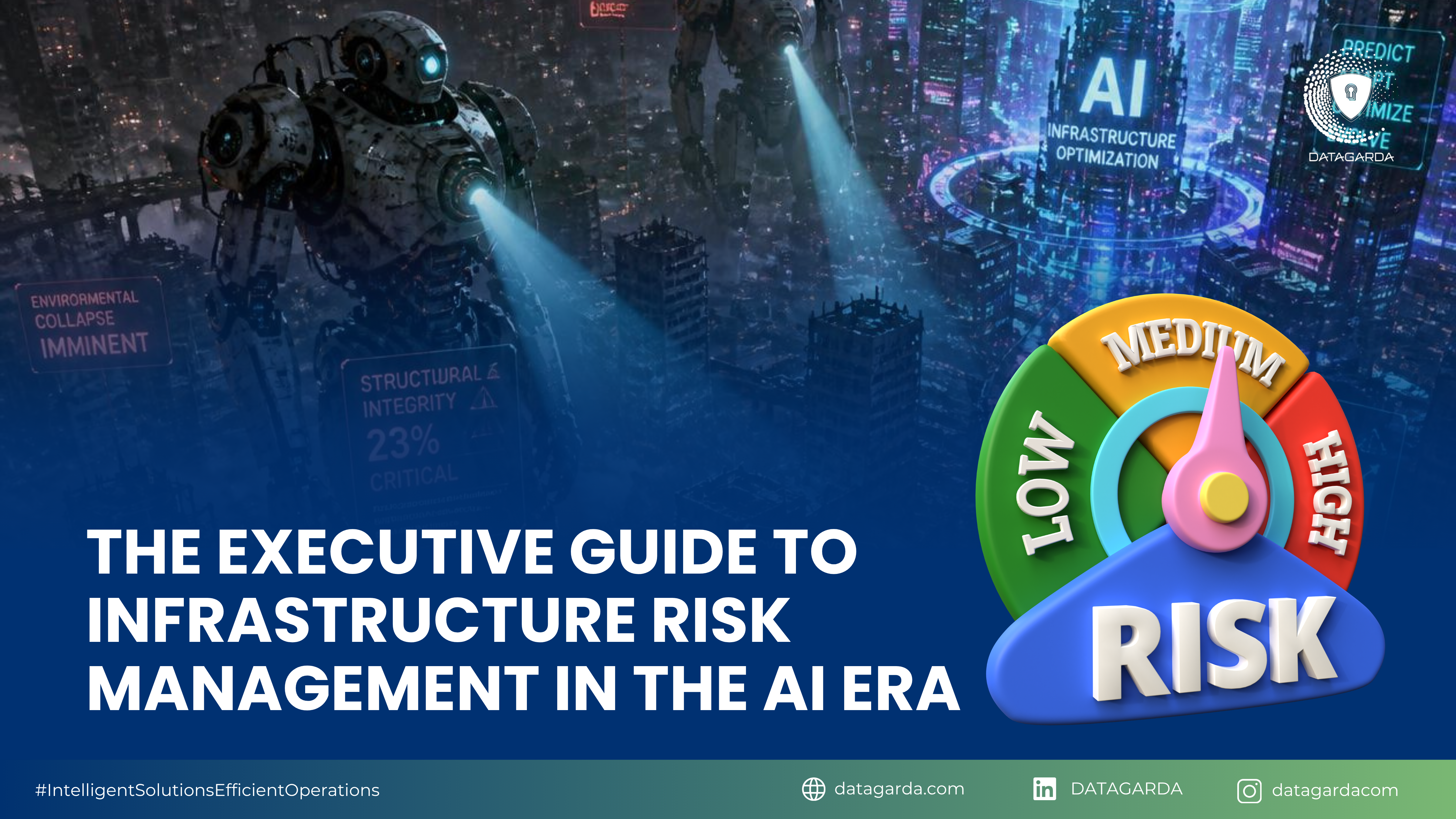
AI Is Reshaping Infrastructure Risk
Artificial Intelligence is redefining how enterprises compete, innovate, and grow. From generative AI and predictive analytics to autonomous operations, organizations are investing heavily in AI-powered capabilities to accelerate business transformation.
Yet behind every successful AI initiative lies an often-overlooked foundation: digital infrastructure.
As AI workloads become larger, faster, and more resource-intensive, traditional infrastructure management approaches are no longer sufficient. Power density, cooling capacity, operational resilience, cybersecurity, governance, and business continuity have become executive-level concerns.
In the AI era, infrastructure risk management is no longer an IT responsibility alone—it is a boardroom priority.
Why AI Introduces a New Category of Infrastructure Risk
Unlike conventional enterprise applications, AI workloads demand significantly greater infrastructure performance.
Organizations face increasing pressure to support:
- High-density computing environments
- Greater power consumption
- Advanced cooling requirements
- Larger storage capacity
- Ultra-low latency connectivity
- Continuous service availability
- Enhanced cybersecurity and data governance
Without a proactive risk management strategy, infrastructure limitations can become business limitations. The question is no longer whether your organization is ready for AI. The question is whether your infrastructure is.
The Five Critical Infrastructure Risks Every Executive Should Understand
1. Capacity Risk
AI adoption can quickly outpace existing infrastructure capacity.
Without long-term forecasting, organizations risk:
- Power shortages
- Cooling limitations
- Rack density constraints
- Insufficient network bandwidth
- Delayed business expansion
Capacity planning should anticipate future demand—not simply react to current utilization.
2. Operational Risk
As infrastructure grows more complex, operational processes become increasingly important.
Manual operations, inconsistent procedures, and limited visibility increase the likelihood of:
- Human error
- Service interruptions
- Delayed incident response
- Maintenance inefficiencies
Operational maturity is essential to maintaining stable AI-enabled environments.
3. Infrastructure Reliability Risk
AI-driven businesses depend on continuous infrastructure availability.
Critical assets—including UPS systems, cooling infrastructure, generators, electrical distribution, and networking—must perform reliably under higher operational loads.
Regular audits, preventive maintenance, and infrastructure assessments help minimize failures before they impact business operations.
4. Governance & Compliance Risk
As AI processes larger volumes of sensitive information, infrastructure governance becomes increasingly important.
Executives must ensure that infrastructure supports:
- Regulatory compliance
- Operational accountability
- Security standards
- Audit readiness
- Executive reporting
- Risk transparency
Governance transforms infrastructure management from reactive operations into strategic decision-making.
5. Business Continuity Risk
Infrastructure failures no longer affect only IT systems.
They disrupt business operations, customer experience, revenue generation, and organizational reputation.
Business continuity planning should include:
- Infrastructure redundancy
- Disaster recovery readiness
- Incident response procedures
- Operational resilience testing
- Executive crisis management
Organizations prepared for disruption recover faster and protect long-term business value.
From Reactive Risk Management to Predictive Infrastructure Intelligence
Traditional infrastructure management often responds after incidents occur. Modern organizations take a different approach. They leverage operational intelligence to:
- Monitor infrastructure health in real time
- Detect anomalies before failures occur
- Forecast capacity requirements
- Prioritize infrastructure investments
- Improve executive decision-making
- Reduce operational uncertainty
Infrastructure risk management is evolving from reactive maintenance to predictive business enablement.
Questions Every Board Should Ask Before Scaling AI
Executive leaders should regularly ask:
- Is our infrastructure capable of supporting future AI workloads?
- Do we have visibility into infrastructure health and operational risk?
- Are critical systems regularly assessed and audited?
- Is our governance framework aligned with business growth objectives?
- Are infrastructure investments driven by long-term strategy rather than short-term demand?
- Can our operations recover quickly from unexpected disruptions?
The answers to these questions define an organization’s digital resilience.
Infrastructure Risk Management Is a Competitive Advantage
Organizations with mature infrastructure risk management consistently achieve:
✔ Greater operational resilience
✔ Improved infrastructure availability
✔ Higher investment efficiency
✔ Faster AI deployment
✔ Better regulatory compliance
✔ Reduced operational costs
✔ Stronger business continuity
Managing infrastructure risk is no longer about avoiding downtime—it is about enabling sustainable business growth.
How Datagarda Helps Organizations Manage Infrastructure Risk
At Datagarda, we help organizations build resilient digital infrastructure capable of supporting future business demands.
Our services include:
- Infrastructure Risk Assessment
- Data Center Audit & Compliance
- Operational Readiness Assessment
- Infrastructure Lifecycle Management
- Operational Excellence Consulting
- Business Continuity & Disaster Recovery Planning
- Executive Infrastructure Reporting
- Governance & Operational Advisory
By combining technical expertise with strategic operational insight, Datagarda enables organizations to reduce infrastructure risk while accelerating digital transformation.
Conclusion
AI is transforming every industry—but AI success depends on infrastructure resilience.
Organizations that proactively manage infrastructure risk will be better positioned to scale AI, protect critical operations, and maintain competitive advantage.
The future belongs not only to organizations that invest in AI, but to those that build resilient infrastructure capable of supporting it.
Infrastructure risk management is no longer an operational necessity.
It is an executive strategy.
Prepare Your Infrastructure for the AI Era
Partner with Datagarda to strengthen infrastructure resilience through operational excellence, governance, risk assessment, and long-term infrastructure strategy.
Build resilient infrastructure. Reduce operational risk. Enable sustainable AI-driven growth with Datagarda.