A Battery Failure Does Not Always Stay at the Battery Level
In critical infrastructure, battery systems are often evaluated through familiar metrics:
Capacity. Runtime. Footprint. Cost.
These metrics matter.
But for data centers and other critical facilities, they represent only part of the decision.
The more important question is:
What happens when a cell-level failure becomes an infrastructure-level event?
A battery problem can potentially move through multiple layers of the operating environment—from an individual cell, to a battery system, to the power infrastructure, and ultimately to business continuity.
This is why battery selection should not be treated as a procurement decision alone.
It should be considered as part of critical infrastructure risk management across the entire lifecycle.
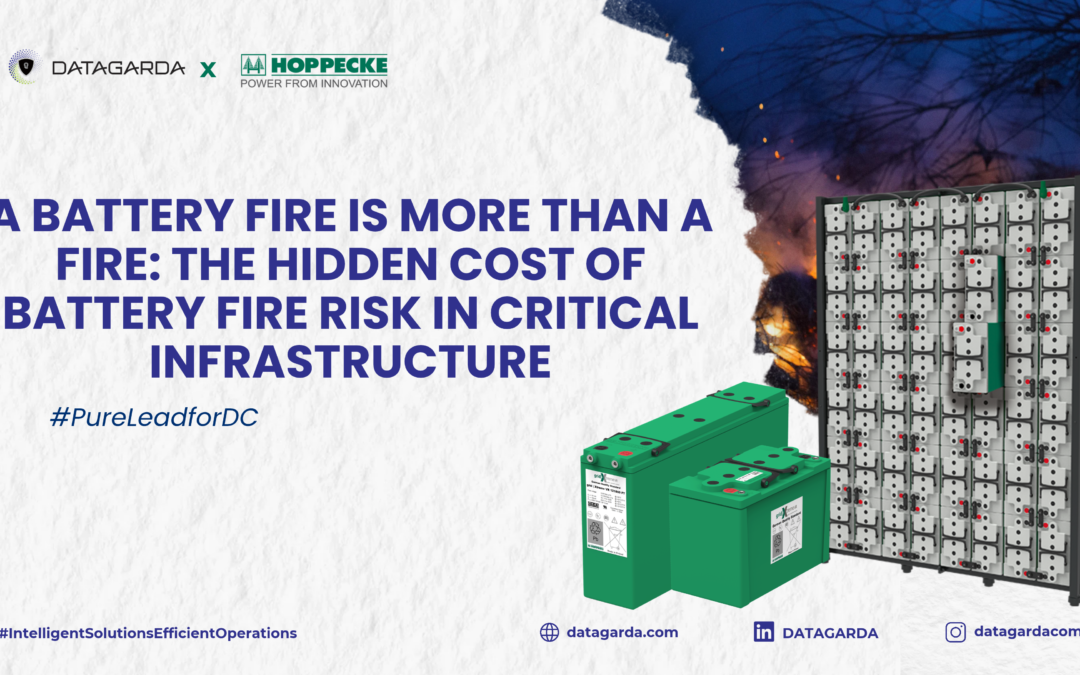
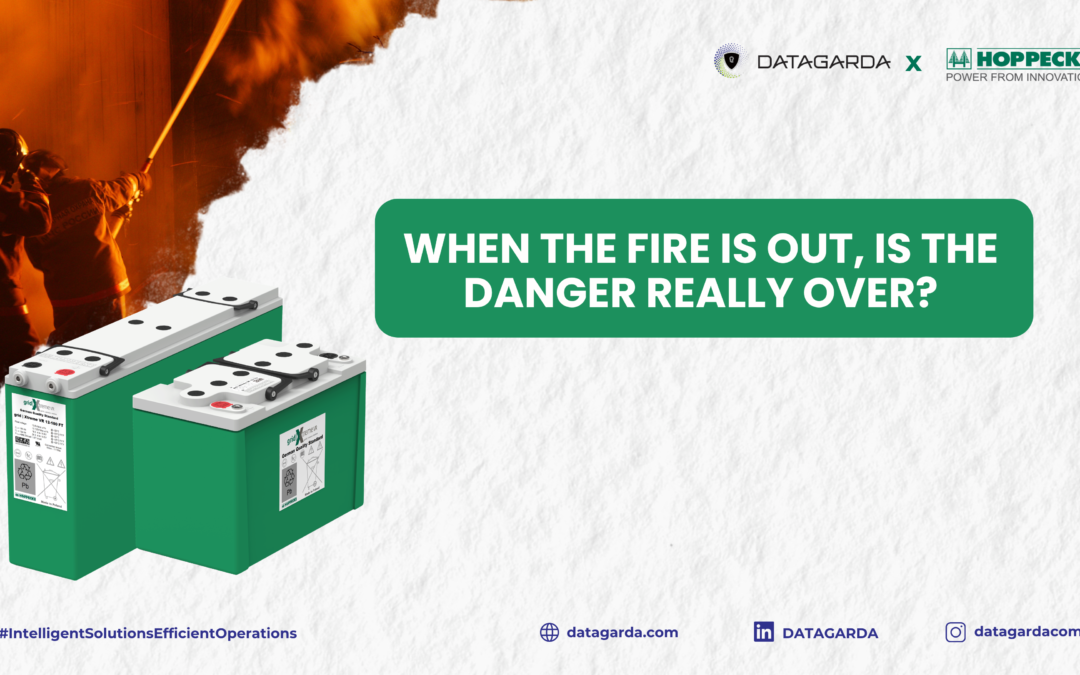
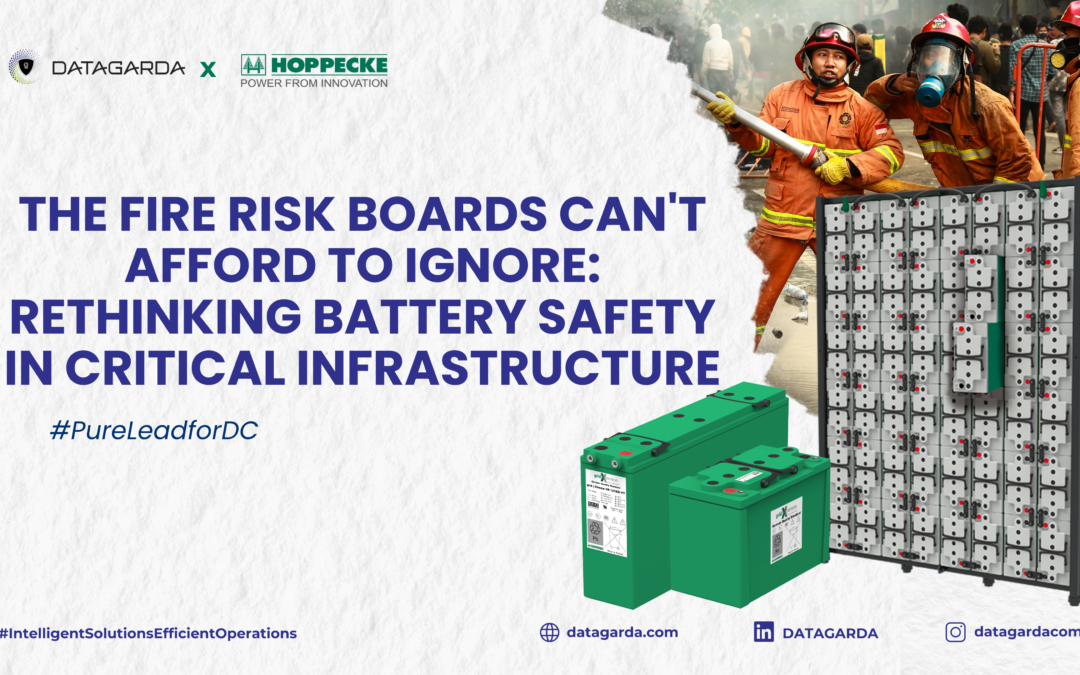
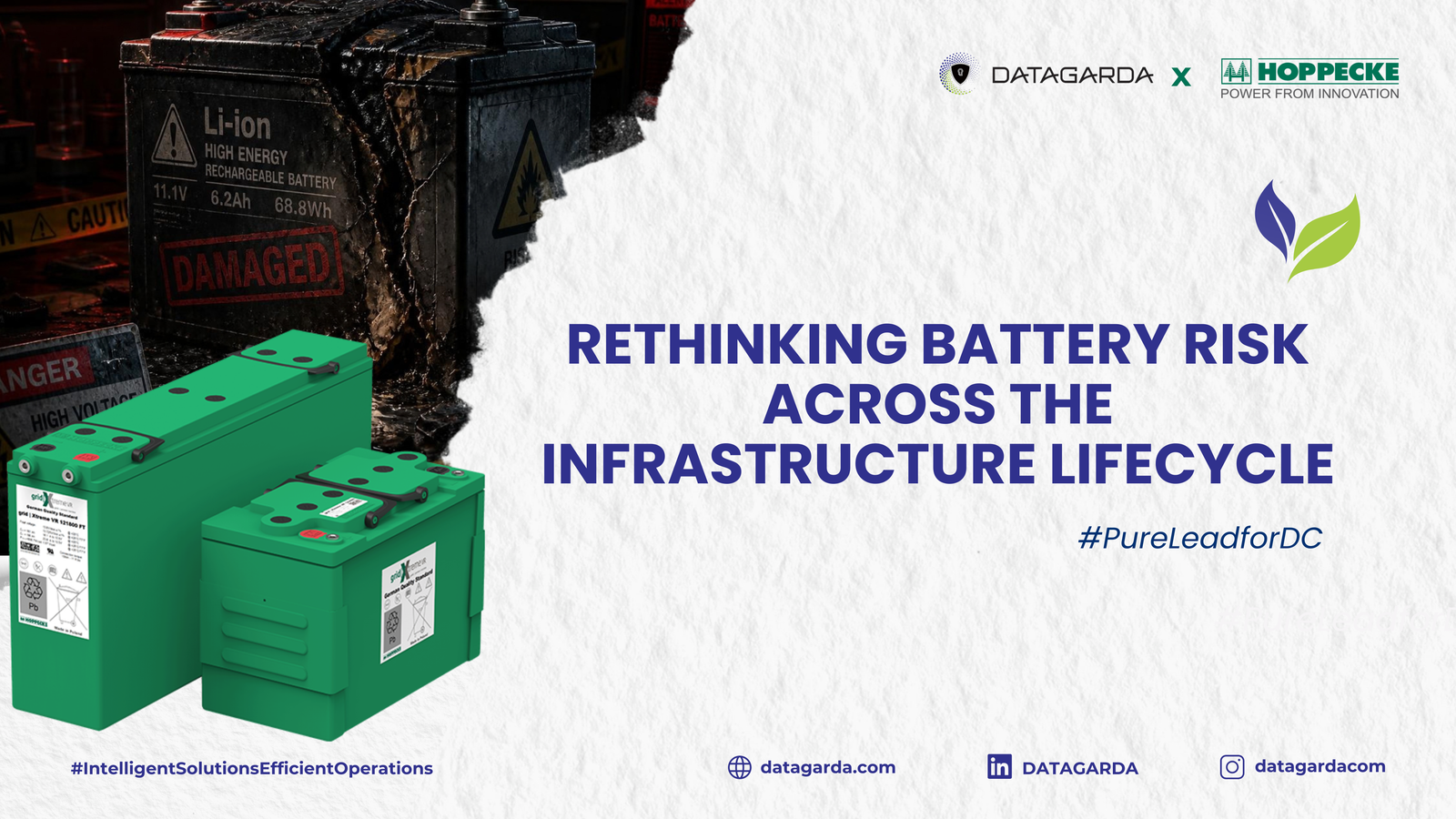
The DataGarda × HOPPECKE campaign highlights thermal runaway, fire risk, operational safety, lifecycle performance, and business continuity as important considerations when evaluating battery technology for critical infrastructure.
The Risk Begins at the Cell Level
One of the significant safety concerns associated with lithium-ion battery technology is thermal runaway.
Thermal runaway can develop as a chain reaction within a battery cell and become difficult to control once initiated.
The risk discussion around lithium-ion systems commonly focuses on conditions such as:
- Overheating
- Physical damage
- Overcharging
The DataGarda × HOPPECKE campaign specifically identifies these conditions within its thermal-runaway risk narrative.
The important issue for infrastructure leaders, however, is not simply understanding what happens inside the cell.
It is understanding what happens next.
A technical failure becomes an infrastructure concern when its consequences can extend beyond the individual component.
That creates a broader chain:
CELL → BATTERY → POWER SYSTEM → FACILITY → BUSINESS
And each step introduces another layer of potential impact.
From Cell Failure to Infrastructure Impact
A battery system does not operate in isolation.
It supports the critical power architecture that protects the availability of IT infrastructure.
That means battery-related risks need to be considered alongside:
- UPS systems
- Electrical distribution
- Battery rooms and cabinets
- Cooling requirements
- Monitoring and maintenance
- Emergency response
- Operational procedures
- Business continuity planning
The DataGarda × HOPPECKE campaign positions the website and educational content as a way to help decision-makers understand these risks in greater depth, with safety, reliability, sustainability, and implementation forming part of the broader infrastructure discussion.
The question therefore changes from:
“Will this battery provide enough backup power?”
to:
“How does this battery technology behave throughout its operating lifecycle—and what does that mean for the infrastructure around it?”
Why Thermal Runaway Becomes an Enterprise Issue
Thermal runaway is a cell-level phenomenon.
Its consequences do not necessarily remain at the cell level.
For a data center, a battery incident can create concerns around:
1. Safety
The first consideration is the safety of personnel, equipment, and the surrounding infrastructure.
Battery technology should therefore be evaluated not only by electrical performance, but also by how its design addresses abnormal operating conditions.
2. Infrastructure Resilience
Critical power systems exist to protect continuity.
If the technology supporting that system introduces additional operational risk, the risk needs to be considered within the broader resilience strategy.
3. Operational Continuity
A battery-related incident can create operational requirements that extend beyond the battery itself—from response and isolation to inspection, recovery, and restoration.
4. Business Continuity
The ultimate concern for the board is not the battery specification.
It is whether an infrastructure incident can affect the organization’s ability to continue operating.
This is where a component-level engineering decision becomes an enterprise risk consideration.
The Infrastructure Lifecycle Changes the Way Battery Risk Should Be Evaluated
Battery risk should not be assessed only when equipment is purchased.
It should be evaluated across the infrastructure lifecycle:
1. DESIGN
Does the selected battery technology align with the facility’s safety, power, environmental, and operational requirements?
2. INSTALLATION
Are battery configuration, physical placement, ventilation, monitoring, access, and maintenance requirements properly incorporated into the infrastructure design?
3. COMMISSIONING
Has the system been properly tested and validated before becoming part of the critical power environment?
4. OPERATION
How does the battery perform under normal operating conditions, high temperatures, partial cycling, and other demanding scenarios?
5. MAINTENANCE
Can the condition of the system be monitored efficiently, and can maintenance activities be performed without unnecessary operational disruption?
6. LIFECYCLE
How does the technology behave as it ages?
What happens to performance, maintenance requirements, operating costs, and risk over time?
7. REPLACEMENT & OPTIMIZATION
When the system approaches the end of its useful lifecycle, how should replacement be planned without creating additional continuity risks?
This lifecycle perspective moves battery management from asset selection toward infrastructure governance.
Beyond Capacity: Evaluating the Technology Behind the Backup
Battery capacity remains important.
But capacity alone does not tell the complete story.
A board-level evaluation should consider at least six dimensions:
| Evaluation Area | Key Question |
| Safety | How does the technology respond to abnormal conditions? |
| Thermal Resilience | How does it perform under elevated operating temperatures? |
| Operational Environment | Is the technology suited to the actual facility conditions? |
| Maintenance | What level of intervention is required throughout its lifecycle? |
| Lifecycle Performance | How does performance evolve over time? |
| Business Continuity | What could a battery-related incident mean for operations? |
This is where technical specifications become strategic decision inputs.
Where Pure Lead Technology Enters the Conversation
The DataGarda × HOPPECKE campaign introduces pure lead battery technology as an alternative approach for critical infrastructure applications, with the communication strategy emphasizing safety, reliability, sustainability, and lifecycle considerations.
HOPPECKE’s grid | Xtreme VR is a pure-lead AGM battery using Enhanced Stability Standard (ESS) technology.
According to the HOPPECKE technical data sheet, ESS is designed to provide:
- Improved resilience against thermal runaway
- Better charge acceptance
- More even voltage behavior
- Longer service life
- Reduced service costs
- Optimized lifecycle costs
The technical design also includes microporous glass-fibre separators combined with ESS technology, self-regulating pressure relief valves per cell with backfire inhibiting, and flame-retardant PC-ABS material. The product is specified with a 15-year design life and an operating temperature range of -40°C to +55°C, with short peaks up to 60°C under the stated conditions.
These characteristics are relevant because the battery environment itself can become an important part of lifecycle performance.
Temperature Is a Lifecycle Consideration
Battery performance cannot be separated from its operating environment.
Data center infrastructure can operate under demanding thermal conditions, and battery systems must be evaluated accordingly.
The HOPPECKE grid | Xtreme VR is designed for a wide operating temperature range, with the technical documentation specifying operation from -40°C to +55°C and suitability for permanently high operating temperatures with short peaks up to 60°C under the stated conditions.
The data sheet also notes that the increased permissible operating temperature range can reduce the need for continuous battery-room air conditioning, creating an operational and lifecycle consideration beyond the battery’s electrical specifications.
This illustrates an important principle:
Battery technology should be evaluated in the environment where it will actually operate—not only in the specification sheet where it is purchased.
Risk Management Should Follow the Asset, Not Stop at Procurement
One of the most common challenges in critical infrastructure is separating technical decisions from operational decisions.
A battery may be selected by one team.
Installed by another.
Commissioned by another.
Maintained by another.
And ultimately relied upon by the entire business.
That creates a governance question:
Who owns battery risk across the lifecycle?
A mature approach requires clear accountability between engineering, operations, facilities, maintenance, risk, and executive leadership.
The objective is not simply to select a battery with the right specification.
It is to ensure that the technology, operating model, maintenance strategy, monitoring practices, and business continuity planning remain aligned throughout the asset lifecycle.
The Boardroom Question Has Changed
For years, the battery conversation could begin with:
How much capacity do we need?
Today, critical infrastructure leaders should be asking a broader set of questions.
How does the technology respond to abnormal conditions?
How does it perform in the actual operating environment?
What maintenance burden will it create?
How does performance change over its lifecycle?
What happens if the battery system experiences a failure?
And ultimately:
What would a battery-related incident mean for business continuity?
These questions move battery selection from a purely technical decision into the broader framework of infrastructure resilience and enterprise risk management.
From Battery Risk to Infrastructure Resilience
A resilient data center is not defined only by how much backup power it has.
It is defined by how effectively its infrastructure can manage:
Risk → Failure → Response → Recovery → Continuity
Battery technology is one component within that chain.
But because it sits within the critical power architecture, its safety profile, operating characteristics, maintenance requirements, and lifecycle behavior deserve consideration at both engineering and executive levels.
The DataGarda × HOPPECKE collaboration is built around this broader conversation: creating awareness of battery-related risks, educating decision-makers on alternative technology approaches, and connecting safety considerations with practical infrastructure decisions.
DataGarda × HOPPECKE: Rethinking Critical Power Risk
DataGarda’s approach is to look beyond individual components and consider how infrastructure decisions affect operational readiness, resilience, governance, and business continuity.
HOPPECKE’s pure-lead technology provides one technology pathway for organizations evaluating critical power battery requirements, with the grid | Xtreme VR documentation highlighting thermal-runaway resilience, high-temperature capability, reduced maintenance requirements, and lifecycle performance.
The broader lesson is simple:
A battery is not just an energy storage asset. It is part of the infrastructure that protects business continuity.
And therefore, battery risk should be managed accordingly.
A Practical Board-Level Battery Risk Checklist
Before approving a critical power battery strategy, leadership should ask:
□ Safety
Have potential battery failure modes been identified and evaluated?
□ Thermal Risk
How does the selected technology perform under elevated temperatures and abnormal conditions?
□ Infrastructure Integration
How does the battery interact with the broader UPS and critical power environment?
□ Operations
Are monitoring, maintenance, inspection, and response procedures clearly defined?
□ Lifecycle
What are the expected service life, maintenance requirements, and lifecycle cost implications?
□ Business Continuity
What is the potential operational impact if the battery system experiences a major failure?
□ Governance
Who owns battery risk throughout the infrastructure lifecycle?
Conclusion: Think Beyond the Cell
A battery failure may begin with a single cell.
But in critical infrastructure, the consequences can extend much further.
That is why the right question is no longer simply:
“How much backup power do we have?”
It is:
“How resilient is the technology providing it—and how prepared is the infrastructure around it?”
For boards, CIOs, CTOs, COOs, infrastructure leaders, and data center operators, battery strategy should therefore be evaluated as part of a broader critical power, infrastructure resilience, and business continuity strategy.
Because protecting uptime starts long before an incident occurs.
It starts with the decisions made at the beginning of the infrastructure lifecycle.