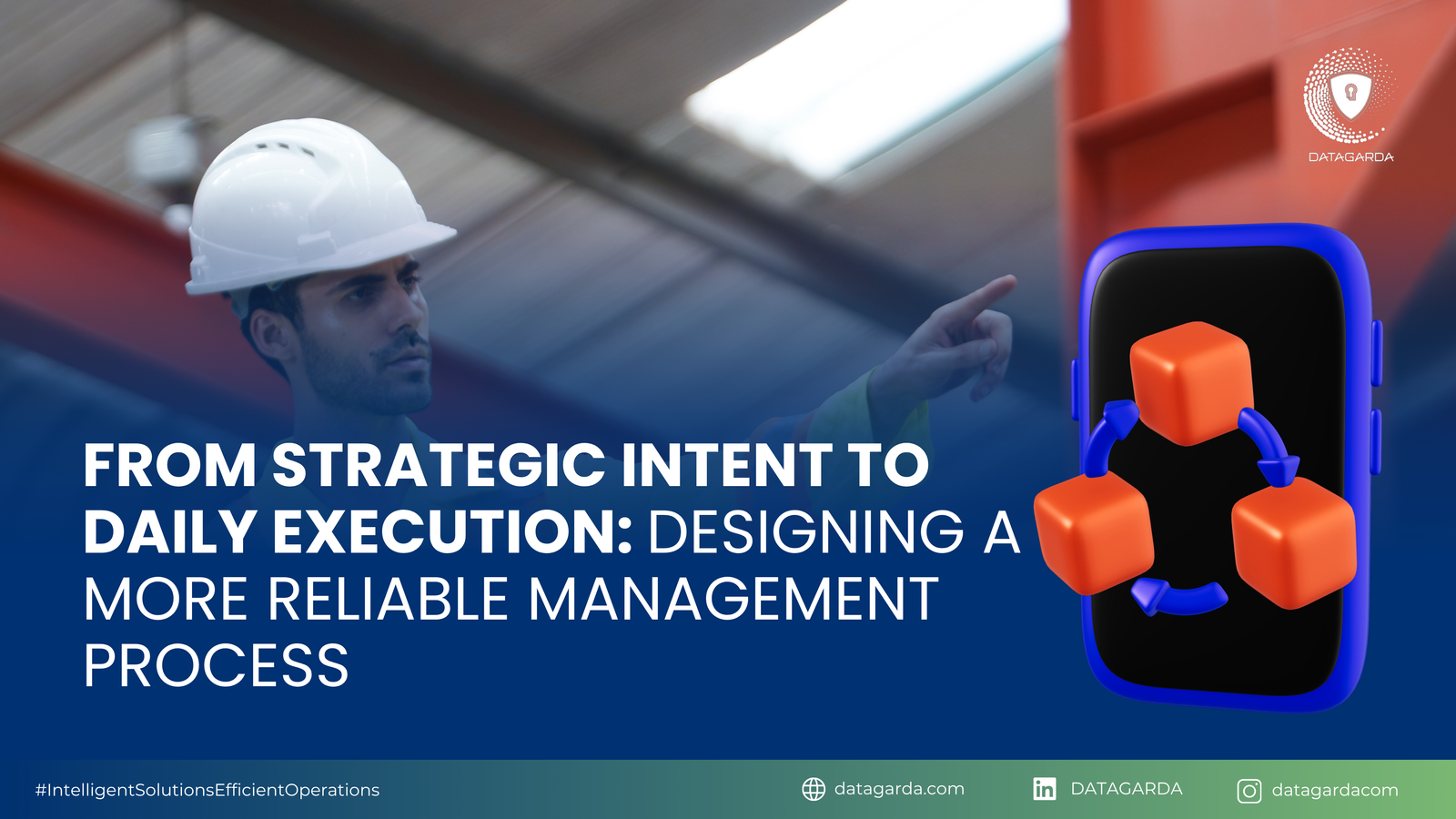
Strategy Creates Direction. Execution Creates Results.
Most organizations do not struggle because they lack strategic ambition. They struggle when strategic priorities must be translated into everyday decisions, responsibilities, and measurable outcomes.
A leadership team may agree on a new initiative, approve a project, or set an ambitious business target. Yet, as the work moves across departments, priorities can become unclear, responsibilities may overlap, and progress can become difficult to assess.
Meetings continue. Tasks are assigned. Reports are produced. But the connection between the original objective and the work happening each day gradually becomes less visible.
This is the strategy execution challenge: turning leadership intent into coordinated, accountable, and repeatable action.
A more reliable management process does not depend solely on individual effort or frequent follow-ups. It establishes the structures that help people understand what matters, who is responsible, how progress is measured, and when intervention is required.
For growing organizations, this is not simply a productivity concern. It is a matter of operational discipline, management visibility, and long-term business performance.
1. Why Strategic Priorities Lose Momentum
A strategy can be clear at the leadership level but difficult to execute consistently across an organization.
The problem often emerges in the transition from high-level objectives to operational responsibilities.
Priorities are not translated into specific actions
Statements such as “improve operational efficiency” or “accelerate project delivery” provide direction, but they do not automatically tell teams what to do next.
Execution requires more specific commitments: defined deliverables, responsible owners, timelines, dependencies, and criteria for determining whether the intended outcome has been achieved.
Without this translation, teams may remain busy without necessarily advancing the organization’s most important priorities.
Accountability becomes distributed but unclear
Cross-functional initiatives often require contributions from multiple teams. This can create uncertainty about who owns the final outcome, who must provide input, and who has the authority to make decisions.
When ownership is unclear, small issues may remain unresolved while each team waits for another to act.
Accountability does not mean assigning blame. It means establishing clear responsibility and ensuring that decisions and commitments have an identifiable owner.
Progress is reported without sufficient context
A completed task does not always indicate that a strategic objective is on track.
For example, a project may report that most activities are complete while a critical dependency, approval, or handover remains unresolved. Without understanding these dependencies, leadership may receive a positive progress report without seeing the issue that could affect delivery.
Reliable execution requires visibility into both completed work and the conditions that may prevent the next step.
2. Design the Management Process Around Five Essential Elements
A reliable management process connects strategic objectives with the decisions and activities required to achieve them.
Five elements help create that connection.
1. Define the intended outcome
Start by clarifying what the organization needs to achieve and why it matters.
An objective should communicate the desired business result rather than simply describe an activity. This gives teams a shared reference point when prioritizing work or resolving competing demands.
The objective should also have a practical way to assess progress. Depending on the initiative, this may include delivery milestones, service performance, quality measures, or other relevant business indicators.
2. Establish ownership and decision rights
Every significant deliverable needs clear ownership.
Teams should understand who is accountable for the outcome, who contributes to the work, who approves key decisions, and when an issue must be escalated.
This structure reduces ambiguity and makes it easier to resolve dependencies before they affect delivery.
It also helps leadership distinguish between a problem that requires additional resources, a delayed decision, and an execution issue.
3. Break objectives into manageable milestones
Large initiatives become difficult to manage when progress is assessed only at the final deadline.
Milestones create intermediate checkpoints that help teams assess whether work is progressing as expected. They also reveal dependencies between activities and provide opportunities to address delays before they become more difficult to resolve.
A useful milestone should have a clear expected result, an owner, a target date, and an agreed method of confirming completion.
The purpose is not to create more administrative work. It is to make meaningful progress easier to understand.
4. Build a consistent review and follow-up rhythm
Management reviews should do more than collect updates.
They should help decision-makers understand what has changed, what is at risk, which decisions are required, and what actions must follow.
A consistent review process connects discussions to documented decisions, assigned actions, and deadlines. It also creates a repeatable way to revisit unresolved issues rather than allowing them to disappear between meetings.
The appropriate review frequency depends on the initiative’s complexity, risk, and pace. The objective is timely intervention, not more meetings.
5. Make exceptions visible early
Not every activity will proceed according to plan. A reliable management process makes it easier to identify deviations and respond appropriately.
Examples include a milestone at risk, a delayed approval, a resource constraint, or a dependency that has not been resolved.
When these conditions are visible early, leaders have more options: adjust priorities, reallocate resources, resolve a decision, or revise a delivery plan.
The goal is to move from reactive follow-up to informed intervention.
3. Connect Daily Work to Strategic Priorities
A management process becomes more valuable when employees can see how their responsibilities contribute to a broader objective.
This requires a clear connection between three levels of execution:
Strategic objectives establish the outcomes the organization wants to achieve.
Management commitments translate those outcomes into initiatives, milestones, resources, and responsibilities.
Daily execution turns commitments into actions, decisions, and deliverables that can be reviewed against the original objective.
When these levels are disconnected, leadership may struggle to determine whether operational activity is producing the intended result.
When they are connected, management can ask more useful questions:
- Which strategic objective does this initiative support?
- What must be delivered next, and who owns it?
- Which dependencies could affect the timeline?
- What evidence shows that the work is progressing?
- What decision or intervention is needed now?
These questions help make execution more deliberate and reduce reliance on informal updates or individual memory.
4. Management Visibility Is More Than a Status Report
Visibility is often associated with dashboards, reports, or project tracking tools. These can be useful, but the value of visibility depends on the quality of the underlying management process.
A report that shows activity without ownership, dependencies, or business context may provide information without supporting a decision.
Effective management visibility should help leaders understand:
- Progress: What has been completed against the agreed plan?
- Accountability: Who owns the next action or unresolved issue?
- Dependencies: What must happen before the next milestone can be achieved?
- Exceptions: Which delays, risks, or decisions require attention?
- Outcomes: Is the work contributing to the intended business objective?
The purpose is not to monitor every action. It is to make the right information available to the right people at the right time.
This distinction matters as organizations grow. More teams and more initiatives can increase the volume of updates without necessarily improving leadership’s understanding of performance.
A reliable process turns information into a basis for decisions.
5. Standardization Creates Consistency Without Removing Flexibility
Organizations need processes that are repeatable enough to support accountability but flexible enough to accommodate different operational realities.
Standardization can establish common expectations for assigning work, tracking milestones, documenting decisions, and escalating issues. It reduces the need for each team to invent its own approach to routine management activities.
However, standardization should not mean applying identical procedures to every situation regardless of context.
A routine internal initiative and a high-risk infrastructure project may require different review frequencies, approval levels, and escalation paths. The underlying principles can remain consistent while the level of control reflects the work involved.
The objective is a management process that is dependable without becoming unnecessarily bureaucratic.
6. Where Management Systems Can Support Better Execution
Clear processes and accountable leadership remain essential. Appropriate management systems can support these practices by making responsibilities, schedules, milestones, and follow-up activities easier to coordinate and review.
For example, project management capabilities can help teams organize initiatives, monitor milestone progress, and coordinate meetings. Organizational management capabilities can support clearer roles, permissions, and responsibility structures.
The important consideration is not the number of tools an organization uses. It is whether the systems support a coherent management process.
Introducing technology into an unclear workflow may simply make existing confusion more visible. Before adopting or expanding management systems, organizations should understand how decisions are made, how work moves between teams, and what information leaders need to manage execution.
Technology should reinforce the operating model—not substitute for it.
7. Measure the Reliability of Execution, Not Just the Volume of Activity
A management process should be evaluated by whether it helps the organization deliver its intended outcomes.
Useful indicators depend on the nature of the work, but may include:
- Milestone completion against agreed schedules.
- Frequency and duration of unresolved blockers.
- Time required to obtain critical decisions or approvals.
- Clarity of ownership for outstanding actions.
- Rework caused by incomplete handovers or misunderstood requirements.
- Delivery outcomes compared with the original objective.
These measures should be interpreted in context. No single metric provides a complete picture of execution quality, and improving a metric should not become more important than achieving the underlying business result.
The objective is to identify patterns, understand where execution is breaking down, and make informed adjustments.
Over time, this creates a stronger feedback loop between planning, execution, review, and improvement.
Conclusion: Reliable Execution Is a Management Discipline
Strategy does not become reality simply because it has been communicated. It becomes reality when objectives are translated into clear responsibilities, manageable milestones, timely decisions, and consistent follow-through.
For leadership teams, the challenge is to create an operating environment where people understand what matters, progress can be assessed, and problems become visible early enough to address.
This requires more than individual productivity. It requires a management process that connects strategic intent with daily execution through accountability, visibility, and operational discipline.
Reliable execution is not about asking people to work harder. It is about designing a process that helps the organization work toward the right outcomes, consistently.
How DataGarda Can Help
Reliable operations depend on clear processes, coordinated execution, and visibility into the work that matters.
DataGarda helps organizations consider operational readiness, management discipline, and the systems that support dependable execution across critical business environments.
Want to strengthen the connection between management priorities and daily execution? Contact DataGarda to discuss how a more structured approach to operational management can support your organization’s goals.
DataGarda — Intelligent Solutions, Efficient Operations.