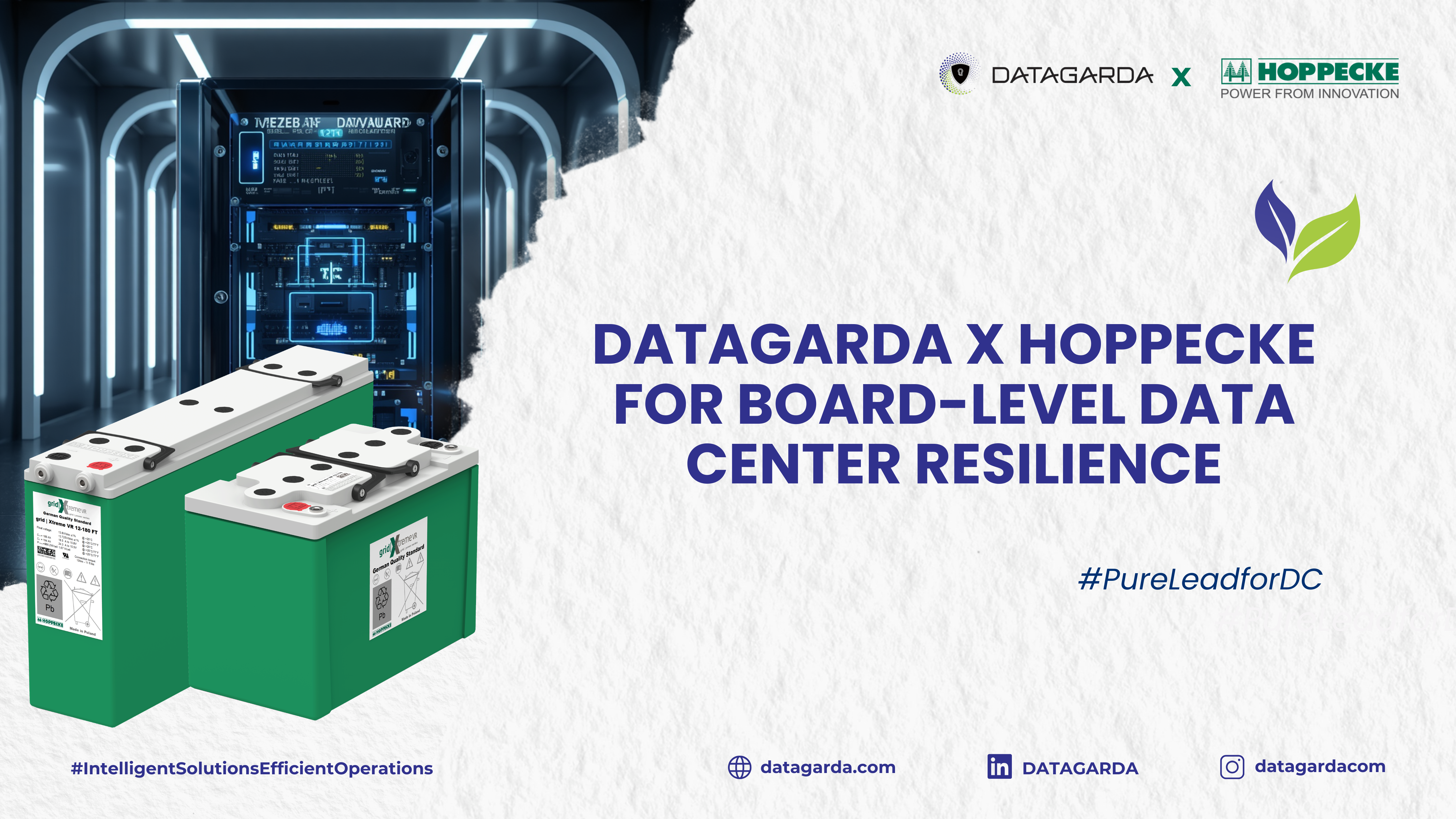
For executive decision makers, data center resilience is no longer a purely technical discussion.
It is a board-level priority that affects business continuity, customer trust, operational reliability, compliance confidence, and long-term digital growth. As data centers continue to support cloud platforms, AI workloads, enterprise systems, financial services, and public digital infrastructure, one question becomes increasingly important:
Can the facility perform when power stability is challenged?
At the center of this question is critical power infrastructure — especially the UPS battery system.
Through the collaboration between DataGarda and HOPPECKE, data center stakeholders in Indonesia gain access to a stronger approach to critical power readiness: one that combines global battery technology with local expertise in data center operations, engineering review, assessment, certification, and lifecycle support.
Why Critical Power Has Become a Board-Level Concern
Data centers are built to support continuous digital services. But continuity depends on more than installed IT capacity or building design.
When power disruption occurs, the UPS battery system becomes a crucial bridge between instability and operational continuity. If the battery infrastructure is not ready, the consequences can affect more than equipment performance. They can affect business operations, customer confidence, and corporate reputation.
Uptime Institute’s Annual Outage Analysis 2024 reported that 54% of respondents in its 2023 survey said their most recent significant, serious, or severe outage cost more than USD 100,000, while 16% said it cost more than USD 1 million. The same analysis also notes that power issues remain the most common cause of serious and severe data center outages.
For executives, this makes critical power a governance issue.
A data center investment should not only be evaluated by design, construction progress, and installed capacity. It should also be evaluated by:
- UPS readiness
- Battery lifecycle performance
- Operational maintainability
- Safety and risk exposure
- Space efficiency
- Sustainability alignment
- Certification readiness
- Long-term resilience
This is where the DataGarda x HOPPECKE partnership becomes strategically relevant.
DataGarda x HOPPECKE: Combining Global Technology with Local Execution
HOPPECKE brings advanced battery technology for critical power applications, while DataGarda brings local data center expertise across operations, project support, digital services, certification, and infrastructure readiness.
DataGarda’s updated company profile highlights its role across Data Center Operations & Management, Data Center Project & Constructions, Data Center Digital Services, and Data Center Certification & Standardizations. Its capabilities include managed operations, facility management, IT and network operations, cybersecurity, project construction, audit/assessment, training, monitoring systems, AI-ready fitout and retrofit, certification support, and continuous improvement.
This matters because technology alone does not create resilience.
A UPS battery system must be properly assessed, designed, installed, monitored, maintained, documented, and integrated into operational procedures. For executive decision makers, the value lies not only in product performance, but also in implementation confidence.
HOPPECKE grid | Xtreme VR: Pure Lead Technology for Critical Backup Power
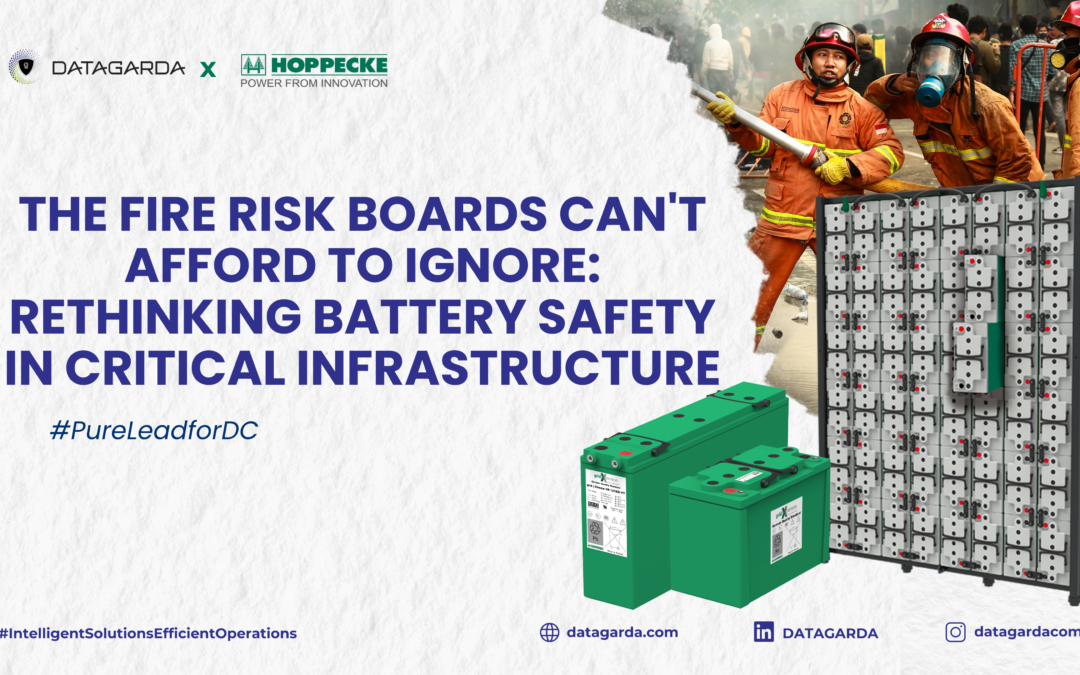
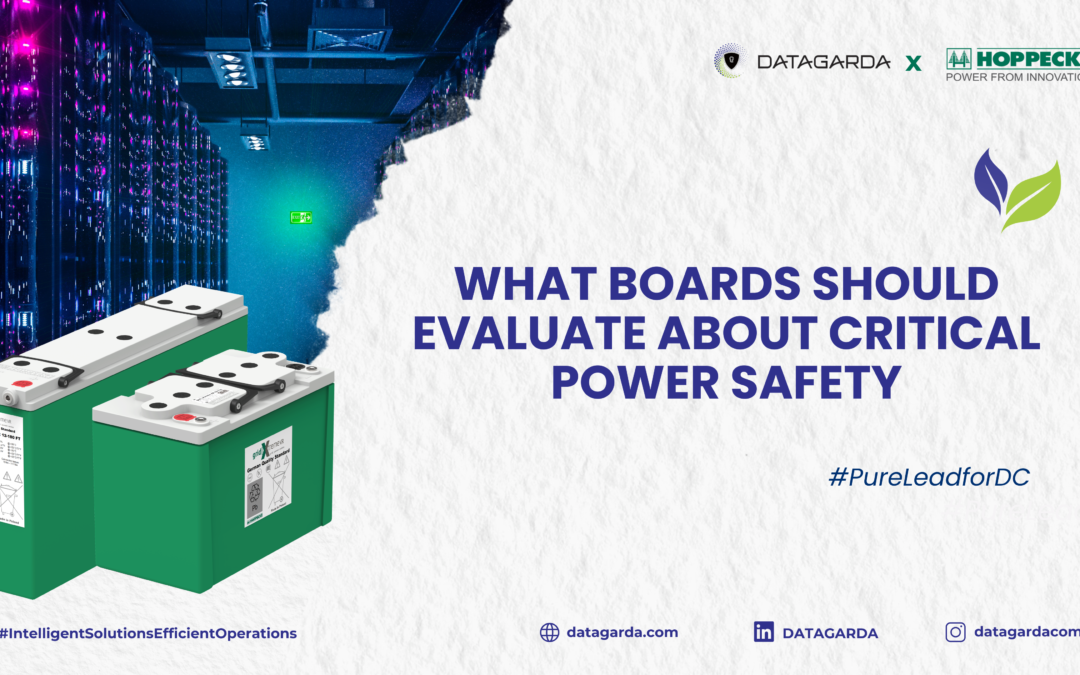
At the product level, HOPPECKE grid | Xtreme VR is designed for demanding standby applications such as data centers and telecommunications. The product uses Pure Lead AGM technology, supporting high-performance discharge capability, corrosion resistance, and long-term stability.
Key features relevant to data center resilience include:
Pure Lead technology
grid | Xtreme VR uses high-performance Pure Lead grid electrodes, helping support strong corrosion resistance and reliable performance in critical applications.
15-year design life
The product is designed with a 15-year design life and optimized aging behavior at elevated temperatures, supporting long-term lifecycle planning.
Wide operating temperature range
grid | Xtreme VR is designed for an operating temperature range from -40°C to +55°C, with suitability for permanently high operating temperatures and short peaks up to 60°C.
Reduced maintenance
The battery does not require refilling with distilled water, helping reduce maintenance complexity across large UPS battery environments.
Flexible installation
grid | Xtreme VR can be installed vertically or horizontally on racks, in battery cabinets, or in grid | XtremeStack.
For board-level stakeholders, these features translate into clearer lifecycle planning, lower operational burden, and greater confidence in critical backup power readiness.
grid | XtremeStack: Space Efficiency for Modern Data Center UPS Infrastructure
Modern data centers face increasing pressure on space.
AI workloads, cloud growth, and higher-density infrastructure are changing how facilities plan power and cooling environments. Schneider Electric notes that traditional enterprise and cloud data centers gradually moved from around 3 kW per rack to around 10 kW per rack, while AI deployments are driving much higher rack densities, with cited examples reaching around 72 kW per rack in 2024 and future projections moving significantly higher.
As rack density increases, UPS battery room planning becomes more strategic.
HOPPECKE’s grid | XtremeStack is designed as a modular stacking solution tailored for grid | Xtreme VR top terminal batteries. It supports compact installation, modular scalability, efficient use of space, and simplified expansion for UPS environments.
In HOPPECKE’s comparison, grid | XtremeStack shows up to 60% reduction in footprint and space requirement, while increasing power density by up to 153% compared with conventional battery rack arrangements.
For executives, this is not only a technical advantage. Space efficiency can influence facility planning, retrofit strategy, expansion flexibility, capital efficiency, and long-term asset value.
UPS Battery Readiness Is More Than Equipment Selection
A common mistake in infrastructure planning is treating UPS battery selection as a procurement decision.
For modern data centers, UPS battery readiness must be connected to operational strategy.
Executives and facility leaders should ask:
- Is the UPS battery system aligned with critical load requirements?
- Can the layout support safe and efficient maintenance?
- Does the system support future expansion?
- Are monitoring and escalation workflows clearly defined?
- Are SOP, MOP, and EOP aligned with the installed infrastructure?
- Is the facility ready for audit, certification, and lifecycle governance?
DataGarda’s COMPRO 2026 highlights capabilities such as standardized operational frameworks, SOP/MOP digital operations platform, automated tracking, integrated reporting, regular performance assessment, efficiency measures, future-proofing strategies, training, certification, and continuous improvement.
This is where the DataGarda x HOPPECKE collaboration becomes more than a product partnership. It supports a broader readiness framework.
Sustainability and Lifecycle Responsibility
Sustainability is increasingly part of executive infrastructure evaluation.
Battery systems are not only assessed by performance and cost, but also by lifecycle responsibility, recyclability, resource management, and environmental accountability.
HOPPECKE’s recycling reference highlights that lead batteries have 99% recycling efficiency, supported by a secured raw material supply chain, sustainable take-back and recycling system, and certifications including ISO 9001, ISO 14001, ISO 50001, and OHSAS 18001.
For data center operators with ESG priorities, this matters.
Critical power infrastructure should support uptime, but it should also align with responsible lifecycle management and long-term sustainability goals.
Risk Governance: The Executive Layer of Data Center Resilience
For board-level clients, resilience is not only about having redundant systems. It is about governing risk across the full infrastructure lifecycle.
Critical power governance should include:
- Infrastructure assessment
- Technical design review
- UPS and battery readiness
- Monitoring and maintenance
- Operational procedures
- Safety controls
- Certification readiness
- Incident response
- Lifecycle planning
- Sustainability review
DataGarda’s profile highlights certification and standardization services, ISO 9001 and ISO 27001, expert team certifications, audit/assessment capabilities, and surveillance certification support for data center compliance.
This supports the broader message: resilient infrastructure is not built by equipment alone. It is built through technology, process, people, governance, and continuous improvement.
Why This Partnership Matters for Indonesia’s Data Center Ecosystem
Indonesia’s digital economy continues to grow, and data centers are becoming foundational infrastructure for cloud services, enterprise platforms, AI, financial systems, and digital public services.
As the market grows, decision makers must ensure that data center investments are not only scalable, but also reliable, efficient, safe, and sustainable.
The DataGarda x HOPPECKE collaboration helps address this need by combining:
- Advanced Pure Lead battery technology
- Space-efficient UPS battery infrastructure
- Local engineering and operational expertise
- Readiness assessment and lifecycle support
- Certification and standardization perspective
- Sustainability and recycling alignment
For executive decision makers, this creates a stronger foundation for infrastructure confidence.
From Critical Power to Executive Confidence
The true value of critical power infrastructure is not only seen during normal operations. It is proven during moments of disruption.
When power stability is challenged, the UPS battery system must perform. The facility team must respond. Monitoring must provide visibility. Procedures must guide action. Governance must ensure accountability.
HOPPECKE supports this confidence through grid | Xtreme VR and grid | XtremeStack. DataGarda strengthens it through local implementation, operations, assessment, certification, and lifecycle readiness.
Together, this partnership supports a more complete approach to board-level data center resilience.
Resilience Requires Technology and Readiness
Modern data center resilience requires more than capacity, design, or construction.
It requires critical power confidence.
HOPPECKE’s grid | Xtreme VR provides Pure Lead technology, 15-year design life, reduced maintenance, and reliability for critical backup power applications. grid | XtremeStack adds space efficiency, modular scalability, and high power density for modern UPS battery infrastructure.
Combined with DataGarda’s expertise in operations, assessment, certification, and infrastructure readiness, the partnership supports a stronger path toward safer, more sustainable, and more resilient data centers in Indonesia.
Is your data center’s critical power infrastructure ready for long-term resilience?
Connect with DataGarda to explore how the DataGarda x HOPPECKE collaboration can support UPS battery readiness, space efficiency, sustainability, and executive confidence for modern data centers.