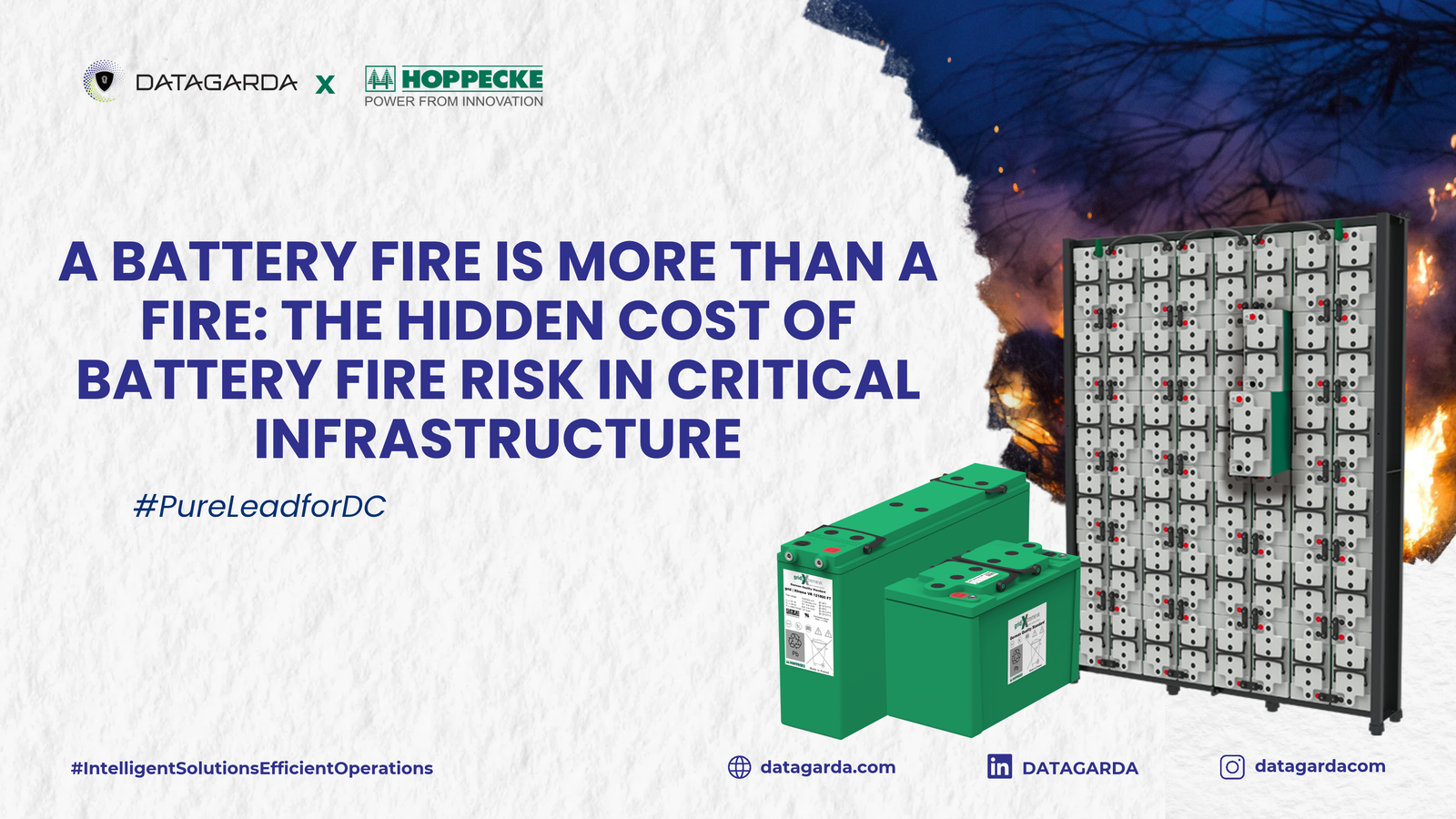
When a Battery Incident Becomes a Business Risk
In critical infrastructure, a battery is more than a backup power component. It is part of the system that helps protect service continuity when the primary power supply is interrupted.
But what happens when the backup power system itself becomes a source of risk?
For data centers and other mission-critical facilities, a battery fire can create consequences that extend well beyond the immediate incident. Smoke and heat may damage nearby equipment, emergency procedures may disrupt operations, and recovery can require inspection, replacement, testing, and recommissioning before normal service resumes.
The financial impact may include equipment losses, operational downtime, service interruptions, and reputational damage. In environments where continuity is fundamental to customer trust, the consequences can reach far beyond the battery room.
This is why battery fire risk should be considered a business continuity and infrastructure resilience priority—not simply a technical specification.
Understanding Lithium-Ion Thermal Runaway
Lithium-ion batteries offer several advantages, including high energy density and compact installation footprints. They are used across many applications, from consumer electronics to energy storage and critical power systems.
However, lithium-ion technology has specific safety considerations, including the risk of thermal runaway.
Thermal runaway is a self-accelerating process in which a battery cell generates heat faster than it can dissipate it. Under certain conditions, the resulting temperature rise can trigger further reactions and potentially affect neighboring cells.
Depending on the battery chemistry, system design, and incident conditions, the event may release hazardous gases, generate intense heat, and lead to fire. A damaged battery may also remain vulnerable to reignition, complicating cooling, monitoring, emergency response, and recovery.
These risks do not mean every lithium-ion installation is unsafe. Risk depends on factors such as cell chemistry, battery design, installation, protection systems, operating conditions, and emergency preparedness.
The executive question, therefore, is not whether one technology is universally safe and another is not. It is whether the selected battery technology and its supporting safeguards align with the facility’s risk profile, operational requirements, and tolerance for disruption.
The Hidden Cost of a Battery Fire
The visible fire is only one part of the potential impact. For critical facilities, the broader consequences can be more significant and longer-lasting.
1. Operational Disruption
A battery incident can affect more than the battery system itself. Smoke, heat, emergency isolation, and safety inspections may affect surrounding infrastructure and delay the return to normal operations.
Even when redundant power systems are available, organizations must understand how an incident could affect the wider facility and its recovery procedures.
2. Equipment Damage and Replacement
The impact may extend to UPS equipment, electrical infrastructure, nearby systems, and other assets exposed to heat, smoke, or emergency response activities. Assessment and replacement can add unexpected costs and extend recovery timelines.
3. Recovery Complexity
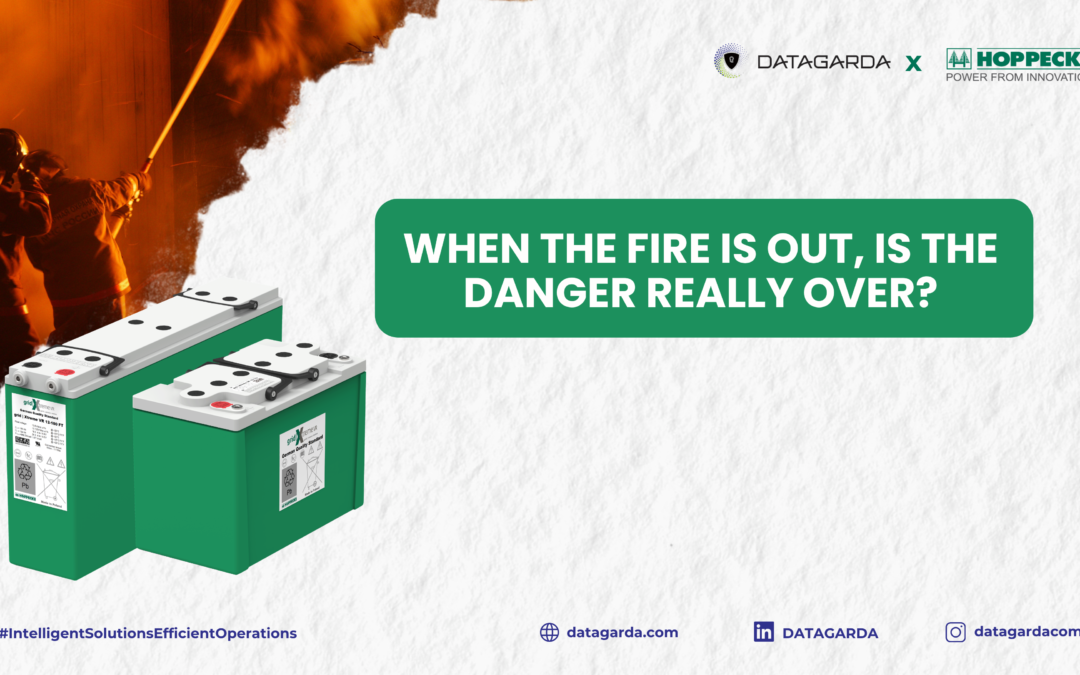
Extinguishing visible flames does not necessarily mean an incident is fully resolved. Depending on the technology and the damage sustained, teams may need continued monitoring, controlled cooling, specialist assessment, and additional safety precautions before equipment can be handled or recommissioned.
4. Financial and Reputational Consequences
Downtime can affect service delivery, contractual commitments, customer confidence, and internal resources. The full cost may include direct repair expenses as well as lost operational capacity and the time required to restore confidence in the affected environment.
The lesson is clear: battery selection should account for the consequences of failure, not only the cost of installation.
A Different Approach to Battery Safety: Pure Lead AGM
One way to evaluate battery fire risk is to consider technologies with different failure characteristics.
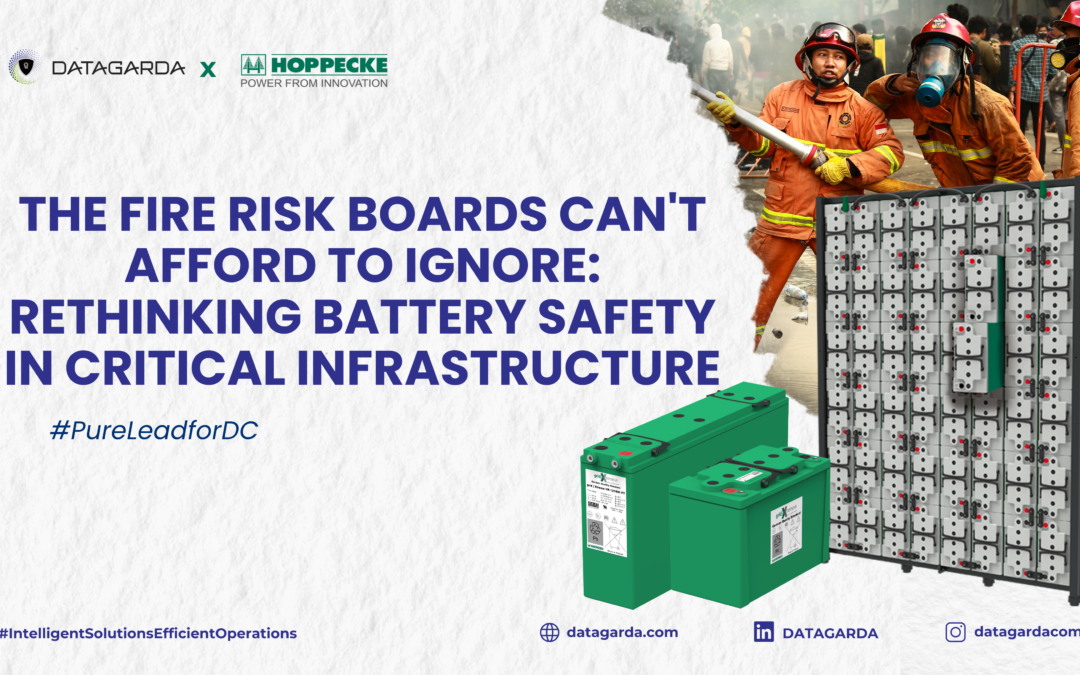
High Performance Pure Lead (HPPL) AGM batteries, including HOPPECKE’s grid | Xtreme VR, offer an alternative for suitable critical UPS applications.
Unlike lithium-ion batteries, lead-acid batteries do not undergo the same lithium-ion thermal runaway mechanism. This difference can be relevant when organizations evaluate battery technology against their facility’s fire-risk profile, operating requirements, and emergency response capabilities.
HOPPECKE’s grid | Xtreme VR is designed for critical power applications, with a stated design life of up to 15 years under specified operating conditions. Actual service life depends on factors such as operating temperature, duty cycle, maintenance, charging conditions, and system configuration.
Pure Lead AGM technology is not risk-free. Lead-acid battery installations still require appropriate ventilation, electrical protection, monitoring, maintenance, and safe handling procedures. Hydrogen generation, electrical faults, and other installation-specific hazards must also be considered as part of a comprehensive safety assessment.
The value of evaluating Pure Lead AGM is not that it eliminates every battery-related risk. It is that it provides a different risk profile that may be appropriate for particular critical power requirements.
The right decision should be based on the facility’s actual load profile, autonomy requirements, available space, environmental conditions, applicable standards, and operational priorities.
Beyond Battery Capacity: The Total Cost of Ownership
Battery decisions are often shaped by initial purchase price, energy density, footprint, and expected service life. These factors matter, but they do not tell the whole story.
For critical infrastructure, a more complete assessment should consider:
- Incident consequences: Potential impact on people, equipment, service availability, and recovery.
- Lifecycle cost: Purchase, installation, inspection, maintenance, and replacement.
- Facility requirements: Ventilation, cooling where applicable, electrical protection, monitoring, and space constraints.
- Operational suitability: Power profile, backup duration, charging requirements, and compatibility with the UPS architecture.
- Recovery readiness: Emergency procedures, incident isolation, inspection, testing, and recommissioning.
- Risk tolerance: The organization’s continuity commitments, redundancy strategy, and acceptable exposure to disruption.
A battery with a lower upfront cost may not represent the most appropriate long-term choice if it introduces constraints or risks that are difficult to accommodate. Equally, a particular technology should not be selected on the assumption that it is always less costly or safer in every application.
The objective is to evaluate the complete lifecycle and risk implications before committing to an infrastructure decision.
Making Battery Safety an Executive Decision
Battery safety becomes more effective when it is integrated into infrastructure planning, rather than treated as a standalone equipment decision.
Executives and infrastructure leaders should ask:
- Does the selected battery technology align with the facility’s risk and continuity requirements?
- Have the installation environment and supporting safety systems been assessed?
- Are maintenance, monitoring, and emergency response responsibilities clearly defined?
- Have lifecycle costs and potential disruption been considered alongside capital expenditure?
- Can the facility safely isolate, assess, recover, and recommission the system following an incident?
These questions connect technical decisions to governance, accountability, and operational readiness.
A resilient power strategy is not defined only by whether backup power is available. It also depends on how well the organization understands the risks within that system—and how prepared it is to manage them.
Design for Resilience, Not Just Backup Power
A battery fire is more than a fire. It can become an infrastructure incident, a continuity challenge, and a business risk with consequences that extend beyond the equipment involved.
For data centers and other critical facilities, battery technology should therefore be assessed through a broader lens: safety characteristics, operational suitability, lifecycle cost, and the ability to maintain or recover essential services.
Pure Lead AGM technology, such as HOPPECKE’s grid | Xtreme VR, may be worth evaluating where its characteristics align with the application’s requirements. The final choice should always follow a site-specific technical and risk assessment.
The key takeaway: Battery selection is not simply a decision about capacity or chemistry. It is a decision about how an organization manages risk, protects continuity, and prepares critical infrastructure for the long term.
DataGarda × HOPPECKE
Beyond battery capacity. Design for resilience.
Planning or reviewing your critical power infrastructure? Connect with DataGarda to evaluate infrastructure readiness, operational resilience, and the risks that should be considered throughout the system lifecycle.
Explore how a more risk-aware infrastructure strategy can support reliable operations and long-term business continuity.