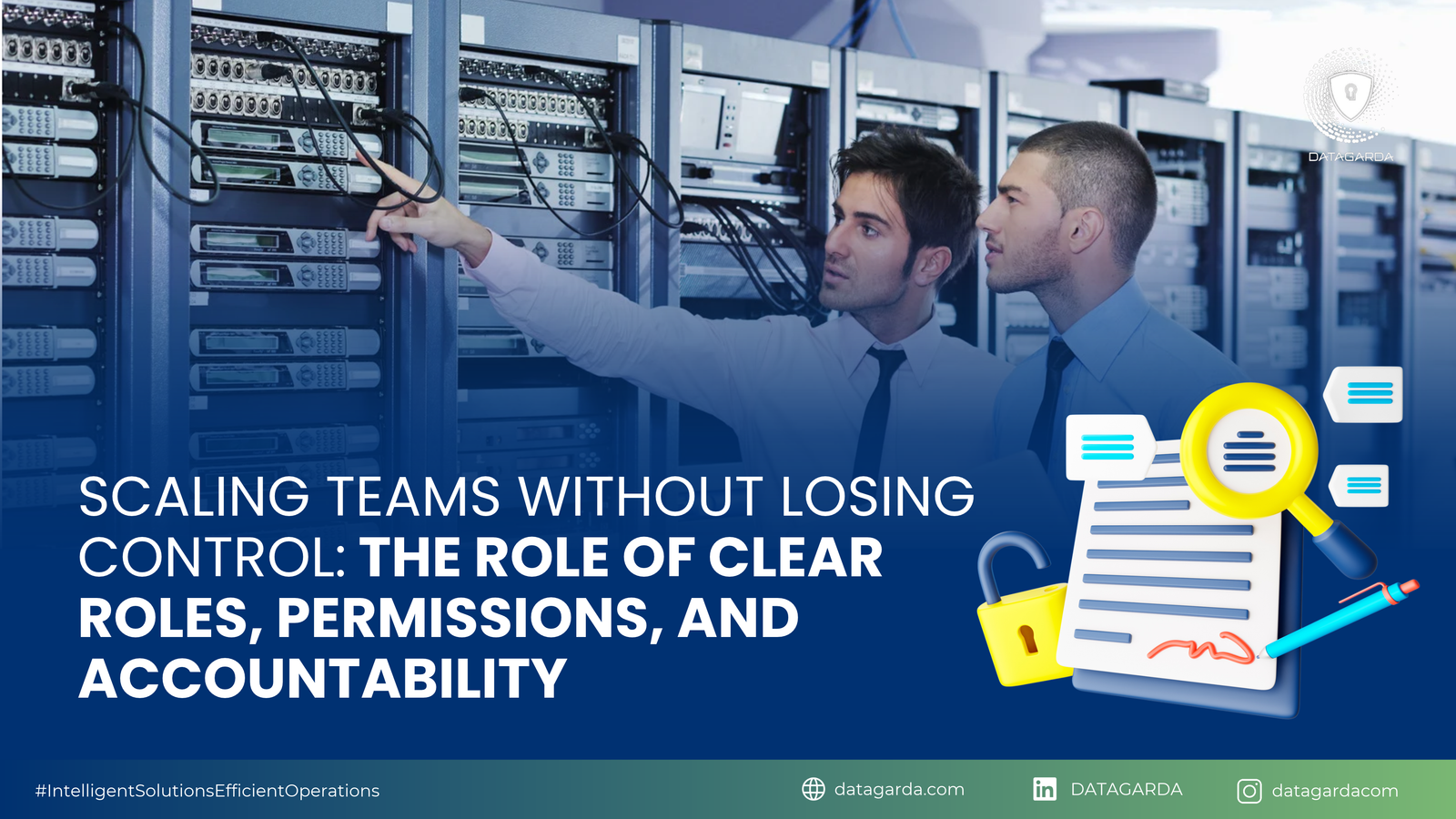
Growth creates opportunities. More people, expanded teams, and additional capabilities allow organizations to take on greater responsibilities and pursue more ambitious objectives.
But as teams grow, coordination becomes more complex.
Decisions involve more stakeholders. Responsibilities overlap. Access to information expands. And what once worked through informal communication may no longer be sufficient to maintain operational consistency.
The challenge is not simply how to scale a team.
It is how to scale without losing clarity, accountability, and management control.
When Team Growth Creates Operational Complexity
In smaller teams, responsibilities are often understood through direct communication and established working relationships.
As organizations expand, these informal arrangements become harder to maintain.
Without clearly defined roles and responsibilities, teams may experience:
- Overlapping ownership and duplicated work.
- Decisions made without clear authority.
- Inconsistent access to information and resources.
- Delayed approvals and coordination.
- Unclear accountability when execution falls behind.
These challenges can gradually affect productivity, project execution, and management visibility.
Team growth does not automatically create operational maturity. It requires a management structure that evolves alongside the organization.
Three Foundations of Controlled Team Growth
Scaling teams effectively requires a balance between flexibility and control. Three operational foundations become particularly important.
1. Clear Roles: Establishing Who Owns What
Every team member should understand their responsibilities, expected contributions, and relationship to broader organizational objectives.
Clear role definitions reduce ambiguity and help prevent responsibilities from becoming fragmented across multiple teams.
They also establish a stronger foundation for coordination, decision-making, and performance accountability.
When ownership is clear, management can better understand how responsibilities are distributed and where execution requires additional support.
2. Appropriate Permissions: Defining Who Can Act
Responsibility and authority should be aligned.
Employees and teams need access to the information, resources, and decision-making capabilities required to perform their roles. At the same time, access and authority should reflect their responsibilities.
A structured approach to permissions helps organizations maintain appropriate control while enabling teams to work efficiently.
The objective is not to restrict collaboration unnecessarily. It is to establish clear boundaries that support responsible execution.
3. Accountability: Connecting Responsibility With Outcomes
Assigning responsibilities is only the beginning.
Organizations also need a consistent way to understand whether commitments are progressing, whether expected outcomes are being achieved, and where intervention may be necessary.
Accountability becomes more effective when expectations are clear, progress is visible, and responsibilities are connected to measurable outcomes.
This allows management to move beyond simply assigning tasks toward maintaining a clearer understanding of execution.
The Importance of Management Visibility
As teams expand, management cannot rely exclusively on direct communication to understand operational progress.
A more structured approach provides visibility into:
- Ownership across teams and activities.
- Decision-making authority and approval responsibilities.
- Progress against organizational priorities.
- Coordination gaps and unresolved dependencies.
- Areas requiring management attention.
This visibility helps leaders identify operational issues earlier and make more informed decisions.
Importantly, management visibility does not mean overseeing every individual activity.
It means having sufficient information to understand how responsibilities, decisions, and execution connect across the organization.
Scaling Requires More Than Additional Resources
Organizations often focus on increasing capacity when preparing for growth.
However, adding people without strengthening operational structures can create additional complexity rather than better execution.
Sustainable growth requires organizations to develop management processes that support coordination, accountability, and consistent execution across expanding teams.
Clear roles establish ownership. Appropriate permissions enable responsible action. Accountability connects responsibilities to outcomes.
Together, these elements create a stronger foundation for operational maturity.
Building Operational Clarity With DataGarda
As organizations grow, the challenge increasingly becomes how to maintain alignment between people, responsibilities, and business priorities.
DataGarda supports organizations in strengthening project management, operational coordination, and execution visibility through structured approaches to planning, responsibilities, and management processes.
By helping organizations establish clearer operational structures and more disciplined execution, DataGarda supports a stronger connection between organizational growth and operational reliability.
For teams managing expanding responsibilities, multiple projects, and increasingly complex coordination, this discipline becomes an important foundation for sustainable performance.
Grow Your Teams. Strengthen Your Operational Control.
Scaling successfully is not only about having more people or greater capacity. It is about ensuring that growth remains supported by clear responsibilities, appropriate authority, and consistent accountability.
Connect with DataGarda to explore how structured project management and operational coordination can help your organization scale with greater clarity, control, and execution discipline.
DataGarda — Intelligent Solutions, Efficient Operations.