Backup Power Is Designed to Protect the Business. But What Risks Does the Technology Introduce?
Backup power is fundamental to data center resilience.
When the primary power supply is disrupted, battery systems play a critical role in maintaining continuity and protecting mission-critical operations.
For years, battery selection has largely focused on questions such as:
- How much capacity is required?
- How long can the system provide backup power?
- What is the expected performance?
- What is the lifecycle cost?
- How efficiently can the system operate?
These remain important.
But as data centers become larger, more complex, and increasingly critical to the digital economy, there is another question that deserves greater attention at the board level:
What happens when the technology designed to provide resilience introduces another category of infrastructure risk?
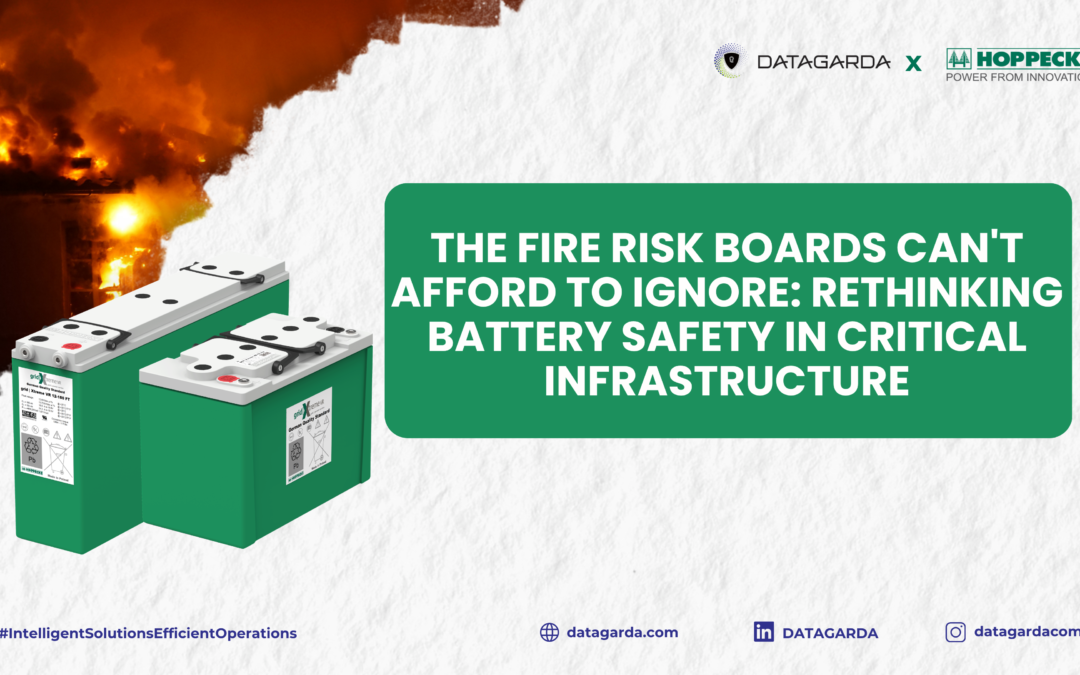
This is particularly relevant when evaluating lithium-ion battery systems and their potential for thermal runaway, fire, and explosion.
The Battery Technology Decision Is Also a Risk Decision
A critical power investment should not be evaluated purely through performance metrics.
Technology selection also requires an understanding of potential failure modes and the conditions that can contribute to them.
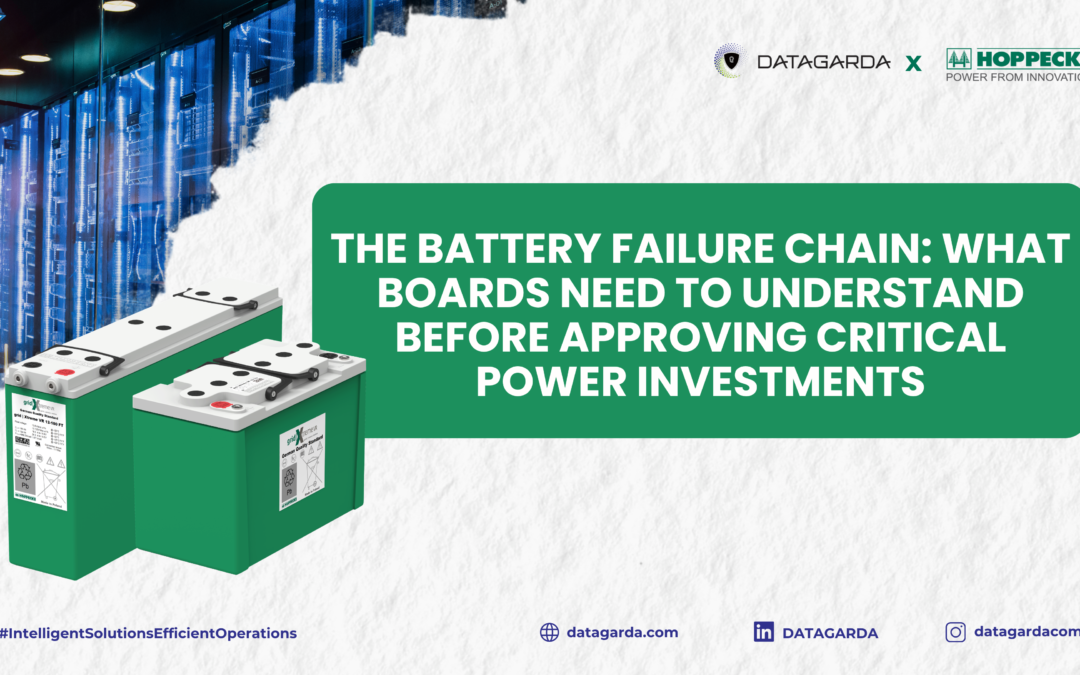
According to the reference material, one of the significant concerns associated with lithium-ion batteries is the risk of thermal runaway, fire, and explosion.
Today’s lithium-ion batteries contain a liquid flammable electrolyte and a flammable plastic separator.
These characteristics make battery technology an important part of the broader infrastructure safety discussion.
For executive decision-makers, the objective is not to reject a particular technology based on a single risk.
Instead, the objective is to understand:
What are the potential failure mechanisms, how are they managed, and what does that mean for the resilience of the overall facility?
Understanding the Fire Risk Chain
One of the most important concepts for executives to understand is the potential progression from an initial battery condition to a much more serious event.
The chain can be viewed simply as:
Overheating
Physical Damage
Overcharging
Thermal Runaway
Fire & Explosion Risk
This chain matters because a battery-related incident does not necessarily begin with fire. It can begin with conditions inside a battery cell that progressively escalate. Understanding this progression allows leadership teams to ask better questions before approving a critical power investment.
1. Overheating: When Temperature Becomes a Critical Factor
Temperature is one of the conditions associated with thermal runaway. The reference material describes thermal runaway as a chain reaction within a battery cell that can be very difficult to stop once it has started.
It occurs when the temperature inside a battery reaches a point that causes a chemical reaction inside the cell.
For boards, this raises an important question:
How is temperature-related risk managed throughout the battery system’s operating lifecycle?
The answer should go beyond simply knowing that the battery is operating within its expected parameters.
Executives should understand how the infrastructure is designed to identify and manage conditions that could potentially escalate.
2. Physical Damage: The Risk Beyond the Cell
Physical damage is another condition identified as a potential contributor to thermal runaway. This highlights why battery safety cannot be considered independently from the environment in which the battery system operates.
Critical infrastructure involves multiple interconnected elements:
Battery → Electrical Infrastructure → Cooling → Monitoring → Operations → Maintenance
A weakness in one area can affect the broader operating environment.
Therefore, battery technology selection should be considered together with installation requirements, operational procedures, inspection, maintenance, and asset management.
The board-level question becomes:
How does the selected battery technology fit within the facility’s overall risk management framework?
3. Overcharging: Why Operational Discipline Matters
Overcharging is also identified as a potential cause of thermal runaway. This introduces another important dimension to the discussion:
Battery safety is not determined by technology alone.
The way a system is monitored, operated, maintained, and managed throughout its lifecycle also matters. This is why critical power strategy should include both:
Technology Selection
and
Operational Discipline
A sophisticated battery system still requires appropriate operating controls and ongoing management.
Thermal Runaway: Why It Matters to the Boardroom
Thermal runaway is more than a technical term. It represents a potential escalation mechanism within a battery cell.
As described in the reference material, once thermal runaway begins, it can be very difficult to stop because the process can become a chain reaction.
The reference also explains that when the internal temperature reaches a certain point, a chemical reaction can occur that produces oxygen inside the battery.
This is significant because the process can contribute to further escalation. For executive leaders, the key takeaway is straightforward:
Understanding battery safety means understanding how a technical condition can potentially become an infrastructure event.
Beyond Performance: Evaluate the Full Risk Profile
Battery technology selection should therefore move beyond a simple comparison of performance and capacity. Before approving a critical power investment, boards should consider at least five dimensions:
1. Performance
Does the technology meet the required power and operational requirements?
2. Safety
What are the potential failure modes and associated risks?
3. Operational Requirements
What controls, monitoring, maintenance, and procedures are required?
4. Lifecycle
How will the battery be managed from installation through replacement?
5. Business Impact
What could a significant battery incident mean for operations, continuity, and business resilience? This broader view creates a more balanced investment decision.
The Questions Boards Should Ask Before Selecting Battery Technology
Rather than asking only:
“Which battery gives us the best performance?”
Executive teams should consider questions such as:
What are the key failure modes of the selected technology?
Understanding failure mechanisms provides context for evaluating infrastructure risk.
What conditions could contribute to thermal runaway?
Overheating, physical damage, and overcharging should be part of the risk conversation.
How will the battery system be monitored?
Visibility is essential to identifying abnormal conditions.
What operational controls are required?
Technology performance depends on appropriate operating practices.
How does battery safety integrate with the facility’s wider fire and infrastructure strategy?
Battery risk should not exist in isolation from the overall data center safety framework.
How will the risk be managed throughout the asset lifecycle?
The initial procurement decision is only the beginning.
Why This Matters as Data Centers Scale
As digital infrastructure expands, critical power systems are becoming increasingly important. At the same time, larger facilities can mean:
- More battery capacity
- More battery assets
- Greater infrastructure complexity
- More operational dependencies
- Greater consequences if critical systems are disrupted
This makes technology selection increasingly strategic.
A board approving a major data center investment is not simply approving equipment.
It is approving part of the organization’s resilience architecture.
That means the decision should consider not only whether the battery can deliver the required backup power, but also how its characteristics fit into the facility’s broader risk and operational strategy.
From Procurement Decision to Infrastructure Strategy
The strongest approach is to treat battery selection as part of a wider infrastructure lifecycle:
ASSESS
Understand requirements, risks, and technology characteristics.
↓
SELECT
Choose technology based on performance and risk considerations.
↓
DESIGN
Integrate the battery system into the wider critical infrastructure environment.
↓
OPERATE
Apply appropriate procedures, monitoring, and controls.
↓
MAINTAIN
Manage asset condition and operational performance.
↓
REVIEW
Continuously reassess risk, performance, and lifecycle requirements.
This approach helps prevent battery technology from becoming a stand-alone procurement decision. Instead, it becomes part of an integrated infrastructure resilience strategy.
The DataGarda × HOPPECKE Perspective
The collaboration between DataGarda and HOPPECKE brings the battery safety discussion into the broader context of critical infrastructure. For DataGarda, infrastructure resilience is closely connected to operational readiness, governance, risk visibility, lifecycle management, and business continuity.
HOPPECKE brings expertise in battery and energy storage technologies.
Together, the discussion moves beyond a simple question of:
“Which battery performs better?”
toward a more strategic question:
“Which critical power strategy best balances performance, safety, operational requirements, lifecycle considerations, and business resilience?”
That is a question that belongs not only in the engineering room—but also in the boardroom.
The Boardroom Takeaway
Backup power exists to protect business continuity. That is precisely why its potential risks deserve executive attention. The potential chain of:
→ Overheating / Physical Damage / Overcharging
→ Thermal Runaway
→ Fire & Explosion Risk
demonstrates why battery technology selection should be approached as more than a technical procurement exercise. Boards do not need to become battery specialists. But they should have enough understanding to ask the right questions about:
Technology. Safety. Operations. Lifecycle. Risk. Resilience.
Because the best critical power investment is not simply the one that delivers backup power.
It is the one whose performance and risk profile have been considered as part of the wider infrastructure strategy.
Make Critical Power a Board-Level Decision
DataGarda × HOPPECKE helps organizations look beyond battery performance to consider the broader implications of critical power technology within mission-critical infrastructure.
Understand the technology. Understand the risk. Make better infrastructure decisions.
Talk to DataGarda
Explore how a more comprehensive approach to critical power, infrastructure resilience, operational readiness, and lifecycle management can support your next infrastructure investment.