The AI Race Is No Longer Just About Technology
Across industries, organizations are accelerating investments in Artificial Intelligence (AI) to improve productivity, automate processes, enhance customer experiences, and create new business opportunities.
Yet as AI adoption increases, many organizations are discovering an uncomfortable reality:
Success is no longer determined solely by the quality of AI models or applications.
It is increasingly determined by the resilience of the infrastructure that supports them.
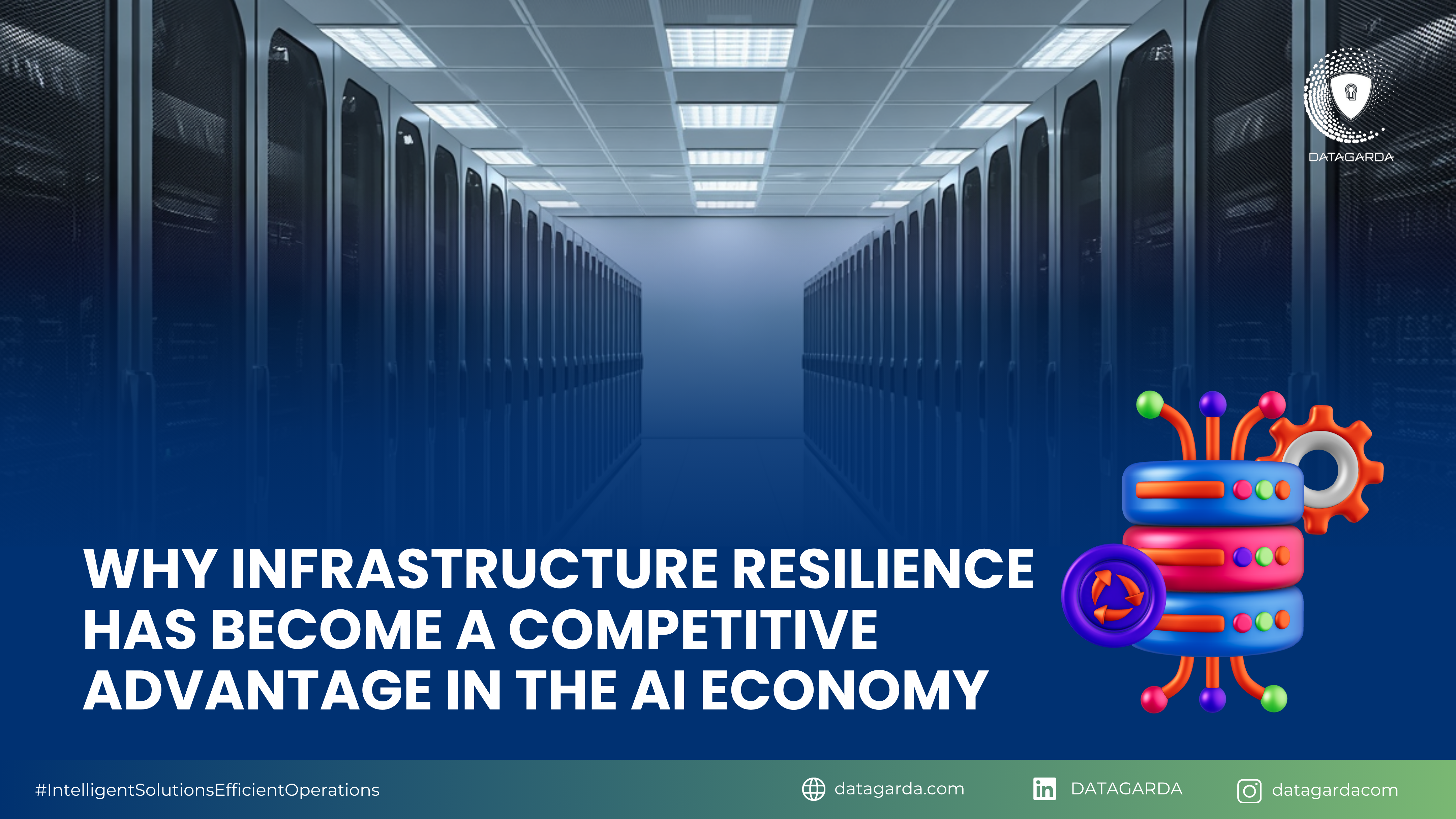
In the AI economy, infrastructure resilience has evolved from an operational requirement into a strategic competitive advantage.
The organizations that can reliably support AI workloads at scale will be better positioned to innovate, adapt, and grow. Those that cannot may find their ambitions limited by operational constraints.
AI Is Redefining Infrastructure Requirements
Traditional enterprise workloads were designed around predictable resource consumption and relatively stable demand patterns.
AI workloads are different.
Training models, running inference engines, processing large datasets, and supporting real-time analytics require:
- Higher computing density
- Increased power consumption
- More advanced cooling systems
- Greater network performance
- Faster scalability
- Continuous availability
As a result, infrastructure is becoming a critical enabler of business performance.
The conversation has shifted from:
“Do we have enough capacity?”
to
“Can our infrastructure sustain future growth?”
Why Resilience Matters More Than Capacity
Many organizations continue to focus primarily on infrastructure expansion.
More racks.
More servers.
More capacity.
While capacity remains important, resilience determines whether that capacity can consistently deliver value.
Infrastructure resilience is the ability to maintain reliable operations despite failures, disruptions, demand fluctuations, or changing business requirements.
It includes:
- Power reliability
- Cooling effectiveness
- Operational maturity
- Risk management
- Business continuity planning
- Governance and compliance
- Infrastructure visibility
Without resilience, growth can quickly become a source of operational risk.
Resilience Creates Business Agility
In today’s digital economy, speed matters.
Organizations must be able to deploy new services, support evolving workloads, and respond quickly to market changes.
Resilient infrastructure enables this agility.
Organizations with mature operational environments can:
✔ Scale faster
✔ Reduce downtime risk
✔ Improve customer experience
✔ Accelerate digital initiatives
✔ Support AI adoption with confidence
✔ Adapt to changing business demands
Infrastructure resilience provides the foundation that allows innovation to occur without compromising reliability.
The Hidden Cost of Operational Weakness
Many organizations invest heavily in technology while underestimating the importance of operational readiness.
Common challenges include:
Aging Infrastructure
Equipment may continue operating while reliability gradually declines.
Limited Visibility
Organizations often lack insight into emerging operational risks.
Governance Gaps
Technology investments can fail to deliver expected outcomes without clear operational accountability.
Reactive Maintenance
Waiting for failures creates higher costs and greater business disruption.
Capacity Bottlenecks
Infrastructure that appears sufficient today may become a constraint tomorrow.
These challenges can limit an organization’s ability to fully realize the benefits of AI and digital transformation.
Operational Excellence Is the New Competitive Advantage
As AI increases the importance of infrastructure performance, operational excellence becomes a differentiator.
Leading organizations are focusing on:
Infrastructure Assessments
Understanding current capabilities and identifying hidden risks.
Operational Intelligence
Moving beyond monitoring to gain actionable insights.
Governance Frameworks
Aligning infrastructure management with business objectives.
Continuous Improvement
Building a culture of resilience and operational maturity.
Business Continuity Planning
Ensuring critical services remain available during disruptions.
The organizations that excel in these areas are often the ones best positioned to capitalize on AI opportunities.
From Cost Center to Strategic Asset
Historically, infrastructure was often viewed as a cost center.
Today, it is increasingly recognized as a strategic business asset.
Reliable digital infrastructure enables:
- Revenue generation
- Customer satisfaction
- Regulatory compliance
- Business continuity
- Innovation
- Market competitiveness
For executive leaders, infrastructure resilience is no longer an operational metric.
It is a business performance indicator.
How Datagarda Helps Organizations Build Resilience
At Datagarda, we help organizations strengthen infrastructure resilience through a combination of operational excellence, governance, risk management, and infrastructure optimization.
Our services include:
- Data Center Operations & Management
- Infrastructure Audit & Assessment
- Operational Readiness Reviews
- Governance & Compliance Support
- Business Continuity Planning
- Infrastructure Optimization Programs
Our objective is simple:
To help organizations build infrastructure environments that are reliable, scalable, and ready to support future business growth.
Conclusion
In the AI economy, competitive advantage is no longer determined solely by technology investments.
It is determined by the ability to operate, scale, and protect the infrastructure that enables those investments.
Organizations that prioritize resilience today will be better equipped to support AI adoption, manage risk, maintain continuity, and accelerate innovation tomorrow.
Because in a world increasingly powered by AI, resilient infrastructure is not just an operational requirement.
It is a business advantage.
Ready to evaluate your infrastructure resilience?
Contact Datagarda today to discuss infrastructure assessments, operational readiness, and resilience strategies that support long-term business growth.
Build a stronger digital foundation with Datagarda.