For many years, the market assumption has been straightforward: if a data center wants a compact backup-power footprint, lithium-ion is usually seen as the default answer. Lead-based systems, even high-performance ones, are often assumed to require more room.
But that assumption is no longer as reliable as it used to be.
The HOPPECKE grid | Xtreme VR and grid | XtremeStack materials suggest that when pure lead batteries are paired with a dense stacking architecture, the footprint gap versus lithium-ion can shrink dramatically, and in some modeled configurations, pure lead can approach or even outperform expected lithium-style footprint benchmarks for standby applications.
Pure lead is not the same as conventional AGM
A key reason is that grid | Xtreme VR is not positioned as a standard AGM product. HOPPECKE describes it as a high-performance pure lead AGM battery designed for UPS, data center, and telecom applications. The data sheet states a 15-year design life, vertical and horizontal installation capability, and an operating temperature range of -40°C to +55°C for the standard version.
The accompanying FAQ explains that HOPPECKE’s HPPL approach uses high-purity unalloyed lead and thin plate technology to deliver higher energy and power density than other lead-acid batteries, while also supporting long service life under elevated temperatures. The same FAQ also says compact design and high power density can help reduce required space significantly in data center applications.
HOPPECKE’s one-pager adds more direct product claims, including:
- 50% space saving compared to standard AGM batteries
- 4x longer storage time
- 2x longer service life compared to standard AGM batteries
- 99% recycling efficiency
That matters because the conversation should not compare lithium-ion against “old lead-acid.” It should compare lithium-ion against a newer pure lead platform with different performance and layout potential.
The system architecture changes the footprint discussion
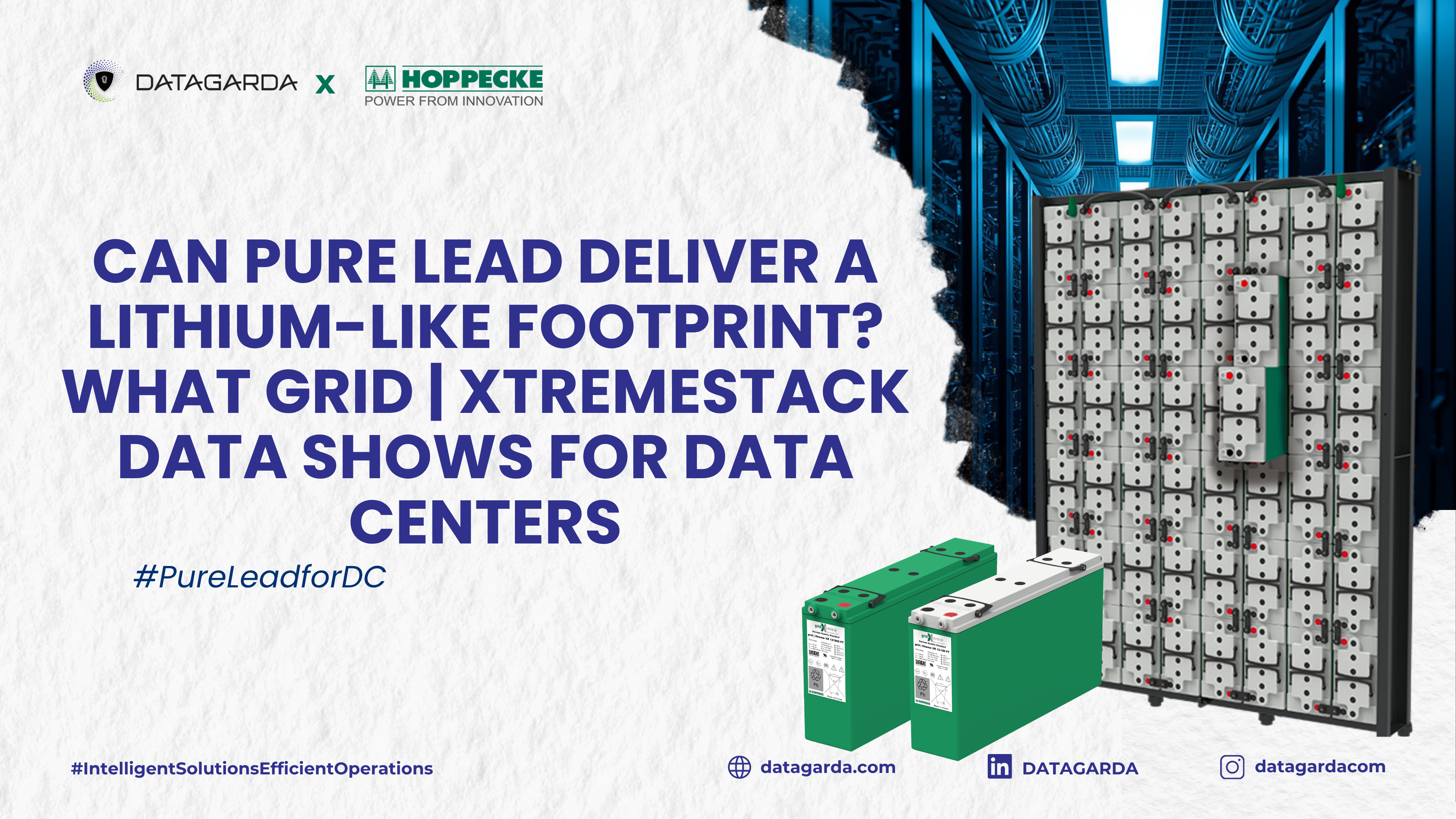
The strongest argument comes from grid | XtremeStack, which is designed specifically around grid | Xtreme VR top terminal batteries.
According to the brochure, XtremeStack is a modular stacking solution for data centers that is both horizontally and vertically expandable. It is built to use space more efficiently than conventional rack layouts, making maintenance and system growth easier over time.
HOPPECKE states several system-level benefits:
- 20% more batteries in the same area
- 27% less space needed
- 22% higher energy density
In another comparison inside the same brochure, HOPPECKE claims that versus a conventional battery rack, grid | XtremeStack delivers:
- -60% footprint
- -60% space requirement
- +153% power density
- -15% service costs
- -19% material and installation costs
This is the core reason the pure lead footprint story has changed. The chemistry matters, but the rack architecture matters just as much.
The most concrete comparison: 1,632 batteries in ~44 m²
One of the clearest proof points in the uploaded material is the direct room-use comparison.
HOPPECKE shows that in roughly 44 m², a conventional rack configuration fits 1,340 batteries, while grid | XtremeStack fits 1,632 batteries.
That is a very practical data center message. Operators do not buy chemistry in isolation. They buy usable capacity, maintainability, and performance per square meter.
So when a stacked pure lead design places materially more batteries into the same room, the classic “lead needs much more space” assumption starts to weaken.
Can pure lead become similar to lithium footprint?
The uploaded XtremeStack presentation goes further and compares a 300 kW for 10 minutes requirement at 20°C to 25°C between lithium-ion and pure lead.
In that comparison:
- the lithium-ion configuration is shown with a 1.90 m² footprint and 3.90 m³ room volume
- the pure lead grid | Xtreme VR 12V-110Ah configuration is shown with a 0.76 m² footprint and 1.56 m³ room volume
That does not mean every pure lead project will automatically be smaller than every lithium-ion project. Real outcomes still depend on autonomy time, voltage window, thermal design, room geometry, and compliance constraints.
But it does support the article thesis clearly: stack-racked pure lead can become similar to lithium footprint, and in some modeled standby scenarios can even compare more favorably than expected.
Temperature strategy matters too
Another important angle is operating temperature.
The HOPPECKE FAQ states that grid | Xtreme VR can operate in higher temperature environments, helping reduce air conditioning demand and lowering operating costs, while its compact high-power-density design helps reduce space requirements.
This is relevant because battery footprint and cooling strategy are closely related in modern data center design. A system that tolerates higher temperatures more effectively can reduce indirect infrastructure pressure, not just battery-room pressure.
Your BDx reference supports that broader market direction. In its LinkedIn post, BDx Data Centers says it implemented Singapore’s Tropical Data Centre Standard (SS 697:2023) at SIN1, raised operating setpoints from 23°C to 25°C, and achieved a 7% reduction in cooling energy while maintaining 100% uptime.
That post is not about HOPPECKE specifically, but it reinforces the same strategic idea: higher-temperature operation, when properly engineered, can materially improve data center efficiency.
Sustainability also strengthens the case
The HOPPECKE sustainability one-pager says lead batteries achieve 99% recycling efficiency, and positions lead batteries as a highly mature closed-loop product compared with lower recycling rates shown for lithium-ion in its comparison graphic.
For data center operators, this matters because the battery decision is increasingly judged not only on CAPEX and footprint, but also on circularity, recycling pathways, and long-term material recovery.
That gives pure lead another angle of competitiveness beyond footprint alone.
The better question today is no longer “Is pure lead bigger than lithium-ion?”
The better question is: What happens when pure lead is redesigned as a high-density battery platform and deployed in a stacking system built specifically for space efficiency?
Based on the HOPPECKE material, the answer is clear: stack-racked pure lead is no longer a traditional large-footprint option. With 1,632 batteries in ~44 m² vs 1,340 in a conventional rack, claims of -60% footprint and +153% power density, and even a modeled 0.76 m² vs 1.90 m² comparison against lithium-ion for one standby scenario, pure lead has become much more competitive in space-constrained data center environments.