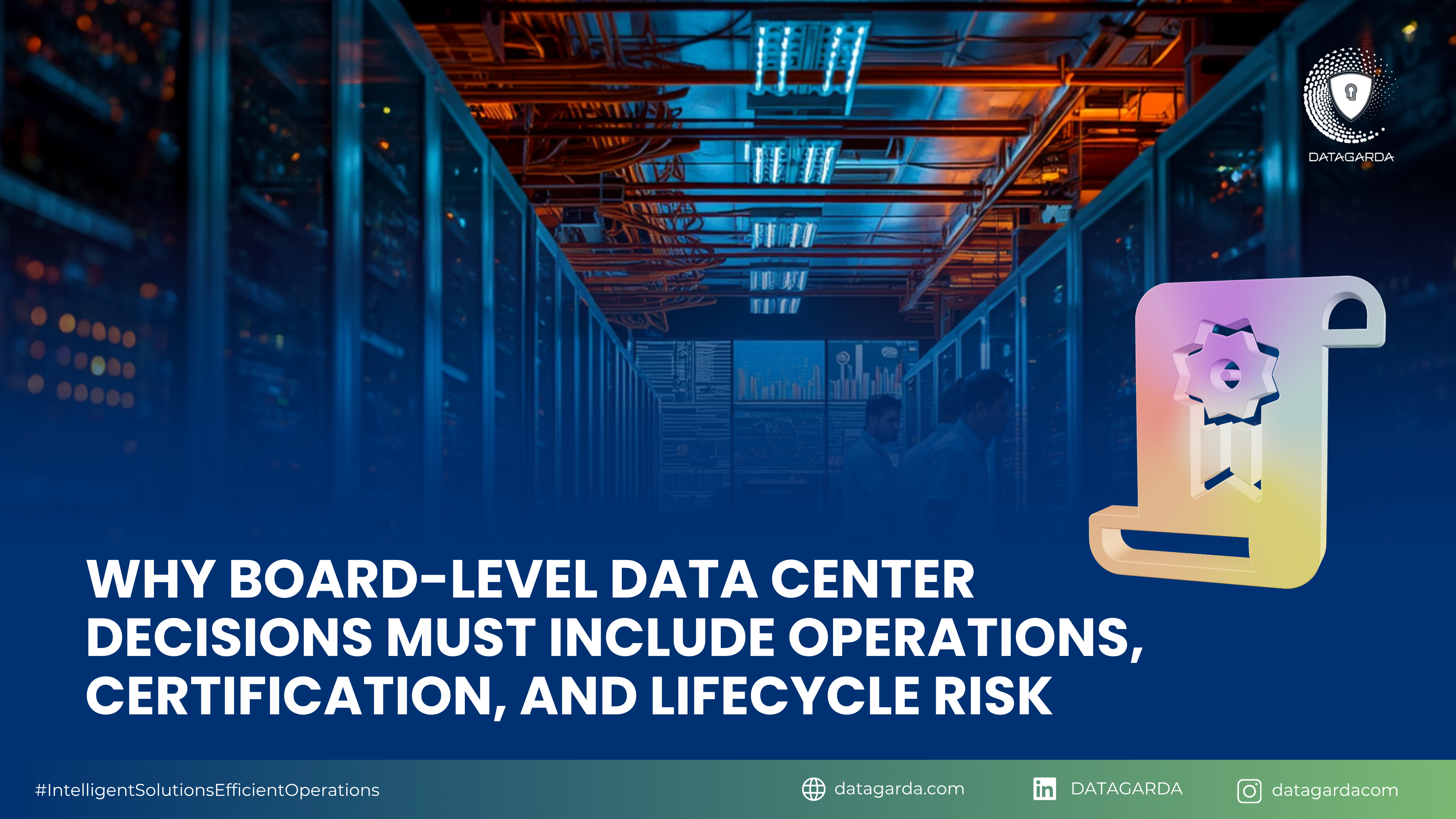
Why Board-Level Data Center Decisions Must Include Operations, Certification, and Lifecycle Risk
For many organizations, data center investment is often evaluated through design, construction timeline, power capacity, location, and capital expenditure.
These factors are important. But for board-level decision-makers, they are no longer enough.
A modern data center is not only a construction project. It is a long-term critical infrastructure asset that must support business continuity, regulatory confidence, customer trust, digital services, cloud adoption, AI workloads, financial systems, and enterprise operations.
This means data center decisions should not stop at the question:
“Can we build it?”
The more strategic question is:
“Can we operate, certify, scale, and govern the risk of this infrastructure over its full lifecycle?”
That is why board-level data center decisions must include operations, certification, and lifecycle risk from the beginning.
Data Centers Are Business Infrastructure, Not Just Technical Facilities
Data centers have become a foundation of the digital economy. They support cloud platforms, enterprise applications, AI workloads, financial services, public services, e-commerce, and mission-critical business systems.
For executives, this changes the way data centers should be evaluated.
A data center is not only an engineering asset. It is a business continuity asset. If it fails, the impact may reach customers, regulators, investors, partners, and internal operations.
Uptime Institute’s Annual Outage Analysis 2024 reported that 54% of respondents in its 2023 survey said their most recent significant, serious, or severe outage cost more than USD 100,000, while 16% said it cost more than USD 1 million. The same analysis also notes that power issues remain the most common cause of serious and severe data center outages.
For board-level leaders, this makes data center resilience a governance issue, not only a technical issue.
Why Construction Success Does Not Guarantee Operational Success
A data center can be successfully designed and constructed, but still face major operational risks.
- This can happen when:
- Operational procedures are not fully developed.
- Maintenance workflows are unclear.
- Incident response is not tested.
- Monitoring systems are not aligned with escalation processes.
- Commissioning does not fully validate real operating conditions.
- The operations team is not prepared for day-to-day complexity.
- Certification readiness is addressed too late.
- Lifecycle risk is not governed from the beginning.
In other words, construction completion does not automatically mean business readiness.
DataGarda’s company profile positions the company across several key areas that cover the full data center lifecycle: Data Center Operations & Management, Data Center Project & Constructions, Data Center Digital Services, and Data Center Certification & Standardizations. Its capabilities include managed operations, facility management, project support, audit/assessment, training, monitoring systems, AI-ready fitout and retrofit, certification support, and continuous improvement.
This lifecycle perspective is important because the long-term value of a data center is created after construction — through how reliably it is operated, maintained, monitored, assessed, certified, and improved.
Operations: The Layer That Protects the Investment
Operations are where infrastructure performance becomes real.
A strong data center design is valuable only when it can be translated into disciplined daily execution. This includes facility operations, IT and network operations, cybersecurity, physical security, power and UPS monitoring, cooling optimization, preventive maintenance, escalation workflows, and incident response.
For board-level clients, operational readiness should answer:
- Are SOP, MOP, and EOP properly developed?
- Are maintenance activities documented and controlled?
- Are critical systems monitored with clear escalation?
- Are operations teams trained and certified?
- Are power and cooling systems continuously reviewed?
- Is incident response tested before real incidents happen?
- Is there a continuous improvement mechanism?
DataGarda’s COMPRO 2026 highlights standardized operational frameworks, SOP/MOP digital operations platform, automated tracking, integrated reporting, regular performance assessment, efficiency measures, training, certification, and continuous improvement capabilities.
For executives, these are not operational details. They are risk controls.
Certification: Turning Infrastructure Claims into Verifiable Confidence
In board-level decision-making, trust must be supported by evidence.
Certification helps transform a data center from a claimed reliable facility into an assessed and verifiable infrastructure asset. It supports confidence among customers, investors, regulators, enterprise clients, and internal stakeholders.
Certification and standardization can help validate:
- Operational discipline
- Security governance
- Quality management
- Infrastructure readiness
- Audit preparedness
- Documentation maturity
- Risk visibility
- Compliance alignment
- Continuous improvement culture
DataGarda’s company profile highlights Data Center Certification & Standardizations, ISO 9001 and ISO 27001, expert team certifications, audit/assessment capabilities, and surveillance certification support for data center compliance.
For board-level audiences, certification should not be treated as a final administrative step. It should be built into the investment strategy from the beginning.
Lifecycle Risk: The Missing Executive Conversation
Many data center projects are reviewed in terms of design, construction cost, and delivery timeline. But lifecycle risk is often under-discussed.
Lifecycle risk includes everything that can affect the facility after it is built:
- Operational failure
- Maintenance gaps
- Power and cooling constraints
- Staffing and competency issues
- Documentation weakness
- Certification delay
- Compliance exposure
- Technology obsolescence
- Capacity expansion limits
- Energy efficiency challenges
- Cybersecurity and physical security risks
- Vendor and supply chain dependencies
- Sustainability obligations
Uptime Institute’s 2025 Global Data Center Survey highlights rising costs, worsening power constraints, and challenges in meeting AI demand. As operators expand and modernize to meet higher power and density requirements, they must also address availability, efficiency, staffing, supply chain delays, and technological uncertainty.
This reinforces why lifecycle risk must be part of board-level discussion. The biggest risks may not appear during construction. They often appear during operation, expansion, certification, and technology transition.
AI and High-Density Workloads Raise the Stakes
The rise of AI makes lifecycle risk even more important.
AI workloads are increasing rack density, power demand, cooling complexity, monitoring requirements, and operational pressure. Schneider Electric notes that traditional enterprise and cloud data centers gradually moved from around 3 kW per rack to around 10 kW per rack, while AI deployments are driving much higher densities. In cited examples, AI rack densities increased from around 25 kW per rack in 2022 to around 72 kW per rack in 2024, with future projections moving even higher.
This changes what executives should ask before approving data center investments:
- Can the facility support future high-density requirements?
- Is power infrastructure ready for future workload growth?
- Can cooling systems manage higher thermal loads?
- Can monitoring detect risks early enough?
- Are SOP and emergency procedures ready for more complex environments?
- Can the facility be retrofitted without major disruption?
- Can the team operate high-density infrastructure safely?
DataGarda’s updated profile includes AI-Ready Fitout & Retrofit, power infrastructure enhancement for high-load scalable AI clusters, environmental monitoring and optimization, and readiness support for high-density AI workloads.
This makes AI readiness a lifecycle issue, not just a design issue.
What Board-Level Data Center Decisions Should Include
To reduce lifecycle risk, executives should evaluate data center investments across a broader set of dimensions.
1. Feasibility and Site Readiness
Before approving investment, leaders should assess whether the site can support the intended business and technical requirements.
This includes power availability, cooling strategy, regulatory context, connectivity, infrastructure condition, sustainability potential, expansion flexibility, and operational risk.
DataGarda’s references include feasibility study and development advisory work, including site readiness, infrastructure requirements, regulatory considerations, and risk assessment.
2. Engineering and Design Review
Design review should not only focus on compliance with drawings. It should also evaluate operational usability.
A strong review should include power systems, cooling systems, network and ICT infrastructure, MEP integration, EPMS/BMS coordination, redundancy, maintainability, and future expansion.
DataGarda’s project references include multidisciplinary engineering review across power systems, mechanical and cooling systems, network and ICT systems, site management, commissioning, and BIM review.
3. Commissioning and QA/QC
Commissioning helps ensure that infrastructure performs as intended before full operation.
For executives, commissioning is a risk reduction mechanism. It validates systems before they support live workloads.
DataGarda’s capabilities include QA/QC management, pre-commissioning and commissioning support, site coordination, documentation support, and technical advisory during project execution.
4. Operational Readiness
Operational readiness includes procedures, people, tools, monitoring, maintenance, escalation, and response.
Board-level leaders should ensure that SOP, MOP, EOP, preventive maintenance, monitoring, and reporting are ready before the facility becomes mission-critical.
DataGarda supports managed operations, facility operations, IT and network operations, cybersecurity, physical security, SOP/MOP frameworks, monitoring, and continuous operational support.
5. Certification and Compliance Readiness
Certification readiness should be integrated early because it affects customer confidence, audit readiness, and operational maturity.
This includes documentation, standards alignment, process discipline, training, security governance, and compliance review.
DataGarda’s certification and standardization services, ISO 9001 and ISO 27001 positioning, expert certifications, and surveillance certification support are relevant to this layer.
6. Continuous Improvement and Risk Governance
A data center is never “finished.”
Technology changes, workloads evolve, regulations shift, and business expectations increase. This is why continuous improvement must be part of lifecycle governance.
A mature data center strategy should include regular assessment, performance optimization, incident review, training, reporting, efficiency improvement, and risk review.
DataGarda’s company profile highlights continuous improvement, regular performance assessment, future-proofing strategies, training, certification, and knowledge sharing.
From Project Delivery to Infrastructure Confidence
For board-level decision-makers, the goal is not simply to complete a data center project.
The goal is to build infrastructure confidence.
That confidence comes from knowing that:
- The feasibility has been assessed.
- The engineering has been reviewed.
- The systems have been commissioned.
- The operations model is ready.
- The team is trained.
- The certification path is clear.
- The risks are governed.
- The infrastructure can evolve with future demand.
This is how data center investment moves beyond construction and becomes a resilient business asset.
How DataGarda Supports Board-Level Infrastructure Confidence
DataGarda supports data center stakeholders across the full lifecycle — from feasibility and engineering review to project support, operations, digital services, certification, training, audit, assessment, and continuous improvement.
This integrated approach helps organizations reduce risk, improve readiness, support certification, and strengthen operational confidence.
For executive decision-makers, this matters because the success of a data center investment is not measured only by how well it is built.
It is measured by how reliably it performs, how confidently it can be certified, and how effectively its lifecycle risk is governed.
Conclusion: The Boardroom Must Look Beyond Construction
Data center investment decisions must evolve.
Design and construction are essential, but they are only part of the lifecycle. The boardroom must also evaluate operations, certification readiness, risk governance, and long-term infrastructure resilience.
In a world shaped by cloud, AI, digital services, and critical infrastructure dependency, data centers must be planned as operational assets from day one.
Because a data center is not truly successful when construction is complete.
It is successful when it can operate reliably, certify confidently, scale responsibly, and manage risk across its full lifecycle.
Is your data center investment ready beyond construction?
Connect with DataGarda to assess feasibility, engineering readiness, operational maturity, certification preparedness, and lifecycle risk governance for your data center infrastructure.
Visit: www.datagarda.com