For years, the common assumption in backup power design has been simple: if you want a compact footprint, you choose lithium-ion. If you choose lead-based batteries, you accept a larger battery room.
But that assumption is becoming outdated.
Based on the HOPPECKE grid | Xtreme VR and grid | XtremeStack materials, modern pure lead battery architecture can significantly reduce the space gap and, in some configurations, deliver a footprint that is highly competitive with lithium-ion for standby power, UPS, and data center applications. The shift is not only about chemistry. It is also about system design, rack architecture, and how batteries are integrated into the available floor area.
Pure lead was already designed to reduce space
The first part of the equation is the battery itself.
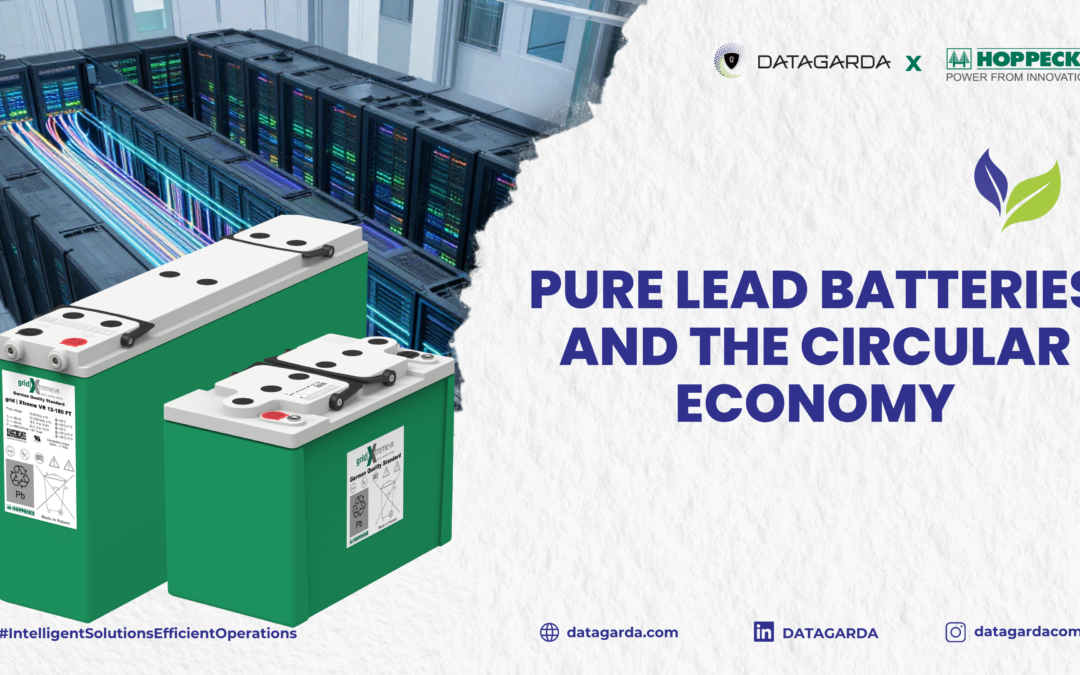
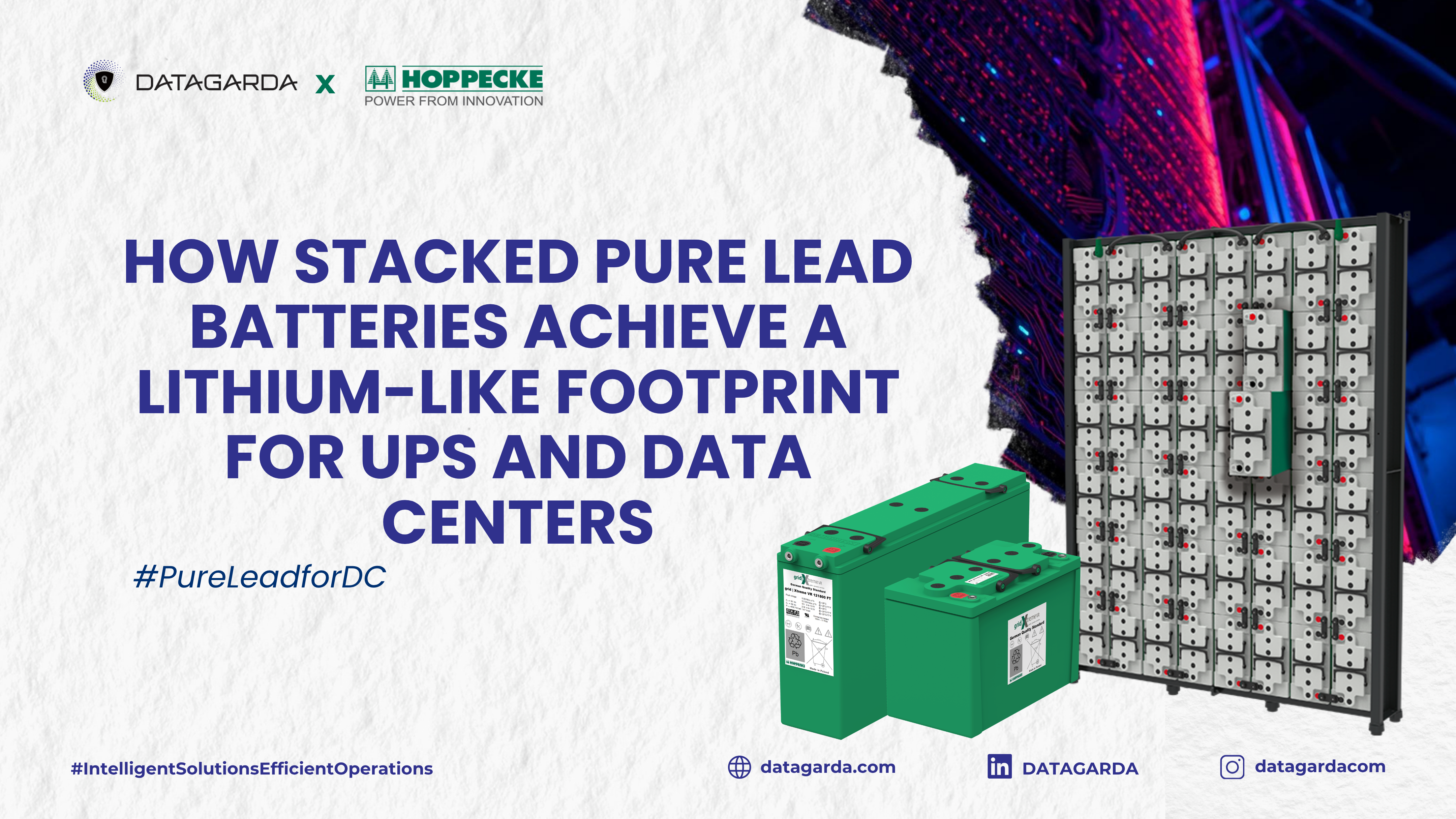
HOPPECKE states that grid | Xtreme VR is a high-performance pure lead AGM battery designed for UPS, data center, and telecom applications. The product literature highlights higher energy and power density through thin plate design, a long service life of up to 15 years at 20°C, storage time of up to 24 months, and operation in demanding environments. The standard datasheet also states an operating temperature range from -40°C to +55°C, with short peaks up to 60°C.
The one-page product summary further claims that grid | Xtreme VR offers:
- 50% space saving compared to standard AGM batteries
- Up to 50% lower CO2 footprint per kWh compared to lithium-ion
- 20% lower CO2 footprint than standard AGM
- 4x longer storage time
- 2x longer service life compared to standard AGM
- 99% recycling efficiency
So even before looking at rack configuration, the product family is positioned as a denser and more sustainable alternative than conventional AGM systems.
The real breakthrough is the stacking concept
Where the story becomes especially relevant for DataGarda readers is the grid | XtremeStack system.
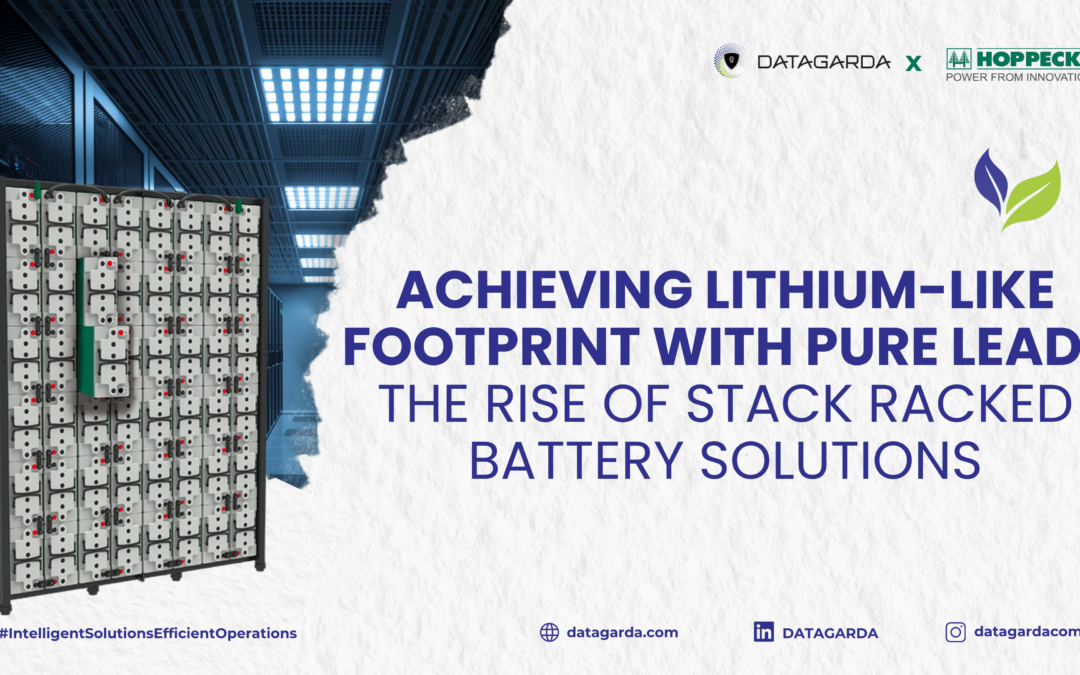
HOPPECKE describes XtremeStack as a modular stacking solution tailored for grid | Xtreme VR top terminal batteries. In the brochure, the company explains that instead of using a conventional battery rack layout, the batteries are stored upright and without gaps. This arrangement is designed to improve space utilization, scalability, and maintenance access while keeping the overall footprint smaller. The same brochure states that XtremeStack is horizontally and vertically expandable, making it suitable for changing UPS performance requirements over time.
According to the brochure, the key system-level benefits are:
- 20% more batteries in the same area
- 27% less space needed
- 22% higher energy density
- easier maintenance access
- modular expansion for future capacity changes
That already makes the case that the footprint challenge of pure lead is no longer only a chemistry question. It becomes a design question.
What the comparison data shows
The strongest argument comes from the comparison figures inside the XtremeStack materials.
In one brochure comparison against a conventional battery rack, HOPPECKE states that in 44 m², a conventional rack fits 1,340 batteries, while grid | XtremeStack fits 1,632 batteries. The same comparison also claims:
- -60% footprint
- -60% space requirement
- +153% power density
- -15% service costs
- -19% material and installation costs
Those figures are significant because they directly address the traditional objection to lead-based backup systems: floor space.
If a pure lead system can place more batteries in the same room while increasing power density, then the decision is no longer “lead versus lithium footprint” in a simplistic sense. The real decision becomes “which full system design delivers the best balance of footprint, cost, maintainability, and lifecycle performance?”
Can pure lead really reach lithium-ion-like footprint?
One of the uploaded XtremeStack presentation slides pushes that argument even further.
In a 300 kW for 10 minutes comparison at 20°C to 25°C, HOPPECKE compares a lithium-ion cabinet solution with a pure lead system using grid | Xtreme VR 12V-110Ah. The slide shows:
- Lithium-ion: 1.90 m² footprint and 3.90 m³ room volume
- Pure lead (XtremeStack): 0.76 m² footprint and 1.56 m³ room volume
- the pure lead system at 40% of the cost of lithium-ion in that comparison
This is the most direct proof point for the website angle you want to build: stack-racked pure lead can be positioned as a solution that reaches a lithium-like, and in this comparison even smaller, footprint.
That does not mean every pure lead installation will always outperform lithium-ion on footprint. Real projects depend on voltage range, autonomy time, temperature, room layout, and compliance requirements. But it does mean the old blanket assumption that pure lead is automatically bulkier is no longer accurate. In a modern stacked architecture, pure lead can compete much more aggressively than many buyers expect.
Why this matters for UPS and data center operators
For data centers and mission-critical facilities, the battery decision is not only about chemistry. It is about how efficiently the system uses expensive white space and technical room area.
HOPPECKE positions grid | XtremeStack specifically for data center environments, noting that it supports easier maintenance, modular expansion, and simplified installation. In facilities where every square meter matters, those are not minor advantages. They affect CAPEX, maintenance planning, future upgrades, and room-level design constraints.
At the battery level, grid | Xtreme VR also brings additional points that matter for standby applications:
- pure lead AGM design
- long service life
- wide operating temperature range
- front-terminal and top-terminal options
- reduced maintenance with no water refilling
- classification as non-spillable for transport under ADR/RID, IMDG, and IATA requirements
For organizations evaluating alternatives to lithium-ion, that combination is commercially important. A buyer may gain a smaller footprint than expected, while also retaining the recycling, supply chain familiarity, and operational profile of a pure lead system. The recycling message is especially strong in the supporting HOPPECKE sustainability sheet, which states 99% recycling efficiency for lead batteries and contrasts that with less than 15% for lithium-ion batteries in the referenced comparison graphic.
Final takeaway
The most useful way to frame this topic is not “pure lead versus lithium-ion” as chemistry alone.
Instead, it is better to frame it as system design plus chemistry.
HOPPECKE’s materials show that when pure lead batteries are paired with a dense stacking architecture like grid | XtremeStack, the result can dramatically reduce footprint, increase power density, and in some modeled cases approach or even outperform lithium-ion footprint expectations for UPS and data center duty.
For operators who need reliable standby power but also need to optimize battery room space, stacked pure lead is no longer the “large footprint” option many still assume it to be.
It is now a serious design strategy.
Suggested reference note for the website
References: HOPPECKE grid | Xtreme VR Brochure (09/2023), HOPPECKE grid | Xtreme VR Data Sheet (12/2024), HOPPECKE grid | Xtreme VR One-Pager, HOPPECKE grid | Xtreme VR Recycling One-Pager, and XtremeStack Presentation uploaded by user.