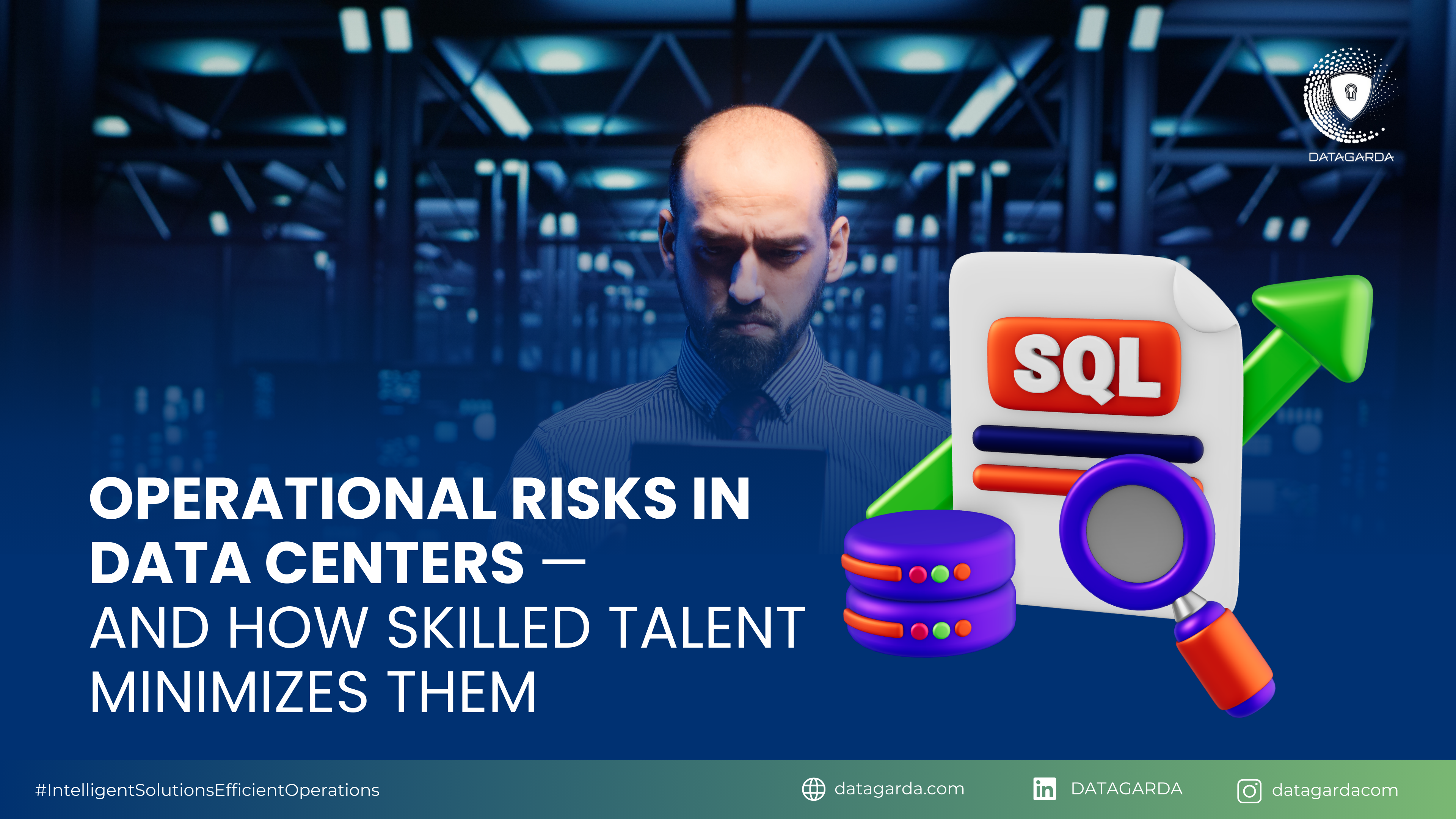
Data centers are mission-critical environments where even minor operational failures can lead to significant downtime, financial loss, and reputational damage. While technology and infrastructure play a vital role, operational risk is most often driven by human and process-related factors.
This makes skilled talent not just a support function, but a core component of data center resilience.
1. Understanding Operational Risks in Data Centers
Operational risks refer to the potential for losses resulting from inadequate processes, system failures, or human error.
Common operational risks in data centers include:
- Incorrect execution of maintenance procedures
- Lack of standardized SOP, MOP, and EOP documentation
- Inadequate monitoring and delayed incident detection
- Insufficient cybersecurity awareness
- Poor coordination during incident response
Without proper mitigation, these risks can escalate rapidly in high-availability environments.
2. Why Technology Alone Is Not Enough
Modern data centers rely on advanced systems such as DCIM, BMS, and EPMS. However, tools are only as effective as the people who operate them.
Technology cannot:
- Replace operational judgment
- Compensate for unclear procedures
- Prevent mistakes without disciplined execution
Skilled professionals are essential to interpret data, anticipate risks, and make timely decisions.
3. The Role of Skilled Talent in Risk Reduction
Well-trained data center professionals significantly reduce operational risk by:
- Executing standardized procedures consistently
- Identifying early warning signs through monitoring systems
- Applying risk-aware decision-making
- Coordinating effectively across teams
Operational maturity is built through experience, training, and continuous improvement—not automation alone.
4. SOP, MOP, and EOP as Risk Control Mechanisms
Standardized documentation plays a critical role in minimizing human error.
When supported by skilled talent, SOPs, MOPs, and EOPs:
- Ensure consistency in daily operations
- Reduce ambiguity during maintenance activities
- Enable faster, more structured incident response
- Support audit and certification requirements
Documentation without competent execution, however, provides only limited protection.
5. Embedding a Security-First Mindset
Cybersecurity risks increasingly overlap with operational risks.
Skilled talent helps minimize these risks by adopting a Protect • Detect • Respond approach:
- Protect: Implementing access controls and preventive measures
- Detect: Monitoring systems and identifying anomalies
- Respond: Executing incident response procedures quickly and accurately
This integrated mindset strengthens both operational and cyber resilience.
6. Talent Development as a Strategic Investment
Reducing operational risk requires continuous talent development, including:
- Standards-based training (TIA-942, ISO 27001, ISO 9001)
- Hands-on operational exposure
- Certification readiness programs
- Ongoing performance evaluation
Organizations that invest in people achieve lower downtime, higher reliability, and stronger compliance outcomes.